
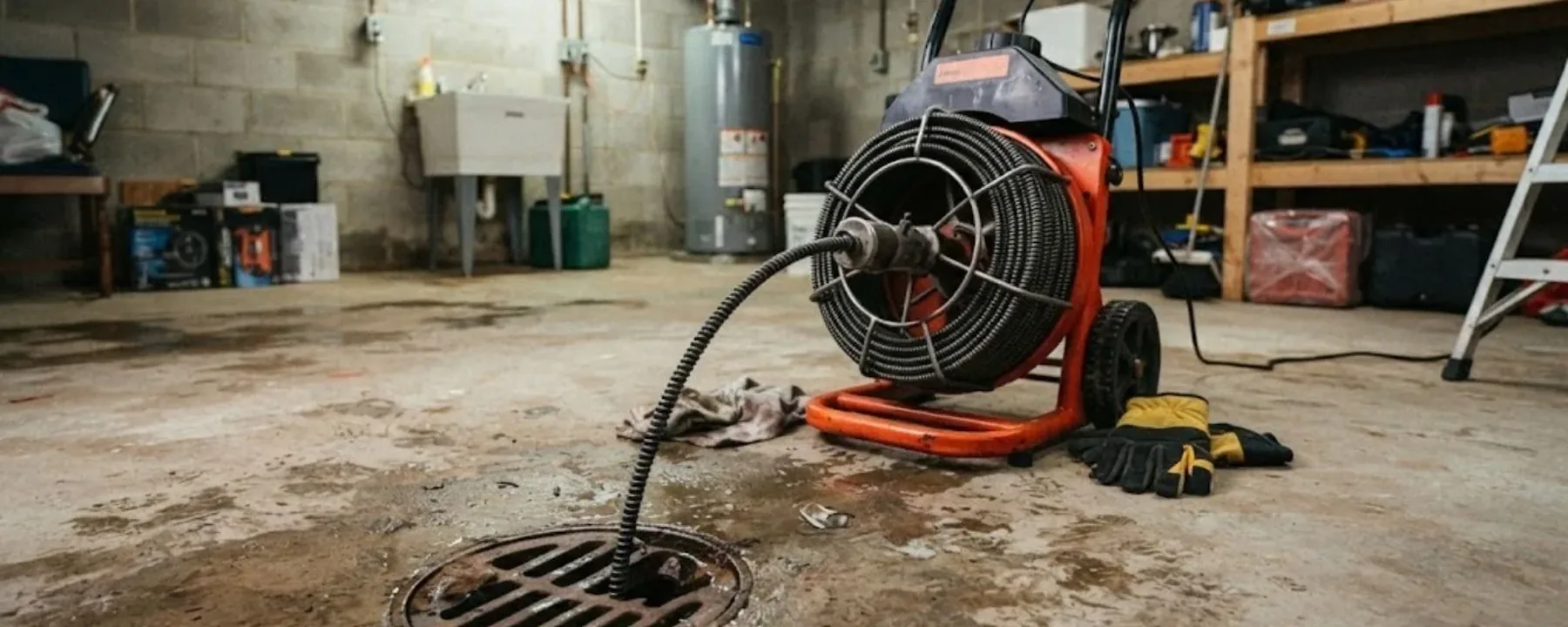
The tub is holding three inches of gray water, the washer just pushed suds up through the basement floor drain, and the kitchen sink gurgles every time someone flushes. Water that cannot leave the pipe will come out of the lowest opening in the house, so treat this as urgent.
Stop running water, keep the washer off, and call (215) 714-6692, because the line is open 24/7 and a dispatcher can tell you which fixtures are still safe to use.
Drain cleaning is the work of clearing a blockage out of a drain pipe with a cable or a water jet so it flows freely again. The right tool depends on where the clog sits and what it is made of, which is why our first questions are about which fixtures are slow and which are not.
What the water is doing, and what it usually means
Standing water in the tub or shower
If the tub fills while the washer drains or a toilet flushes, the branch line they share is restricted. A tub that is slow all by itself usually has hair and soap packed in its own trap.
Washer backing up
A washer pumps out a lot of water quickly. If it overflows the standpipe or shows up in a floor drain, the pipe past that point is partly blocked, often coated with lint and soap scum.
Floor drain bubbling or smelling
A basement floor drain sits low on the system, so it is often the first place a deeper blockage announces itself. Bubbling when upstairs fixtures run is a warning to stop using them.
Gurgling after a flush
Air is being pulled through a trap because water cannot move past a restriction. It is an early sign, and it usually gets worse before it gets better.
Every drain slow at the same time
When several fixtures slow together, the blockage is probably past the branches and in the main. See sewer line cleaning for how that job differs.
One bathroom sink, nothing else
A single slow sink is usually hair, toothpaste and soap in the trap or the tailpiece. It is often a quick job and rarely an emergency.
If water is rising in the tub or floor drain right now
A backing-up drain can spill onto finished floors within minutes. These steps keep the damage small until a plumber gets there.
Stop adding water
Turn off the washer, hold the dishwasher and skip the shower. Every gallon you send down goes to the same blocked pipe and has to come out somewhere.
Do not flush again
A toilet that is still draining slowly can overflow on the next flush. Lift the lid and watch the bowl before you try it.
Protect the floor
Roll up rugs, lift boxes off the basement slab and put towels around a bubbling floor drain. Photograph any water that has already spread.
Keep chemicals out of it
Pouring drain opener into a pipe that is already full leaves caustic water sitting in the line. It also puts the next person who opens the trap at risk.
Call and describe the pattern
Tell the dispatcher which fixtures are slow, which still work and whether the washer was running. That pattern tells us whether to bring a small cable machine or a longer one, and we will say if same-day service is open to you.
Water coming up where it should be going down?
Stop running water and call. A dispatcher answers at any hour.
Finding the clog: from the fixture to the pipe
Where the symptom shows up tells a plumber a lot about where the blockage sits. This map is a starting point, not a diagnosis, because a camera or a test run can overrule it.
| What you see | Where the clog probably sits | What usually clears it |
|---|---|---|
| One sink or tub slow, everything else normal | The trap or the short branch behind that fixture | A plunger, a hand auger or a small cable |
| Tub fills when the washer drains | The shared branch line serving the bathroom and laundry | A cable through a cleanout or the washer standpipe |
| Kitchen sink and dishwasher both back up | The kitchen branch past the disposal, often grease | A cable first, with a jet if grease keeps returning |
| Floor drain bubbles when upstairs fixtures run | The main drain below the basement floor | A larger cable through the main cleanout, see sewer line cleaning |
| Clog returns every few weeks | Buildup on the pipe walls the cable punched through but did not remove | A water jet, see hydro jetting, after a camera look |
These are common patterns, not a guarantee of where a particular blockage sits.
Why a clog keeps coming back in a 1950s house
The median home in Abington Township was built in 1956, and about 61 percent of its 23,232 homes predate 1960, according to Census American Community Survey estimates for 2020 to 2024. Drain lines from that era are often cast iron or clay, and both can develop rough scale or shifted joints that catch grease and paper.
That is why a clog that returns within weeks often means the cable opened a hole but left the buildup on the pipe walls. If you have had two visits for the same drain, ask for a camera look before the third. Houses in Glenside and Jenkintown share this vintage, so the advice carries over.
Kitchen sink clogs: grease, food and the disposal
Kitchen sinks clog differently from bathroom drains. Cooking grease cools inside the pipe and coats the walls, coffee grounds and rice settle in the low spot of the trap, and a garbage disposal grinds food into a paste that sticks to the grease. The sink drains a little slower each week until one evening it stops.
If only one side of a double sink backs up, the clog is usually in the tailpiece or the trap right below it. If both sides are full and the dishwasher water is sitting in the basin, the blockage is farther along in the branch line behind the wall. A disposal that hums but will not spin is a separate problem, covered under garbage disposal repair.
A plunger and a bucket under the trap handle the simple cases. Chemical openers are often a poor idea in a kitchen line, since they sit in standing water and can harm older pipe. When the trap is clear and the sink still will not move, a plumber runs a cable through the trap arm or a cleanout and clears the grease from the branch.
Snaking or jetting: which tool for which clog
Snaking, also called cabling, feeds a spinning steel cable into the pipe until it hooks or cuts through the blockage. Hydro jetting sends high-pressure water through a hose and scours the pipe walls clean. Neither one is better in every case, and the wrong choice can waste a visit.
| The situation | Snaking (cable) | Water jet |
|---|---|---|
| Hair, soap or a toy lodged in one fixture's line | Usually enough and the faster job | More than the job needs |
| Grease or scale coating the pipe walls | Opens a channel, but the coating often stays | Scours the walls, which is the point of the method |
| Tree roots in the line | Cuts a path, and roots regrow | Cuts and flushes, once a camera confirms the pipe can take it |
| The cable stopped partway and will not go farther | The sign that something other than a soft clog is in the way | Not until a camera shows what stopped the cable |
| Broken, offset or collapsed pipe | Can snag or push debris into the break | Wrong tool, see sewer inspection first |
A stuck cable is a reason to look inside the pipe before trying anything stronger.
When the drain is not clogged but leaking
Not every wet-floor call is a clog. A drain line can leak at a joint or a crack, and the signs are a damp spot under a bathroom, a stain on the ceiling below a tub, or a sewer smell with no slow drain to explain it.
Water only leaks from a drain pipe while something is running through it, so the wet spot tends to grow after a shower or a laundry load and dry out between. A look under the fixture and a camera run tell the plumber whether it is a joint to reseal or a section to replace. A leaking drain needs repair, not cleaning, so the job moves to leak detection or, for a buried line, sewer line repair.
What stays out of the drain
Abington Township's Wastewater Utilities Department runs the public sewer system and treatment plant, and it asks residents to wipe oil-coated cookware with a paper towel and bin it before washing, to use the garbage disposal less and to stop flushing cleaning wipes. The Township calls the problem FROG, for fats, roots, oil and grease. The same habits protect your own drain line.
- Cooking grease and oil Wipe the pan, bin the paper towel and let bacon fat cool in a can for the trash. Hot water only moves grease farther down the line before it hardens.
- Wipes of every kind Wipes labeled flushable often hold together long enough to snag on a rough pipe wall. The Township specifically asks residents to stop flushing cleaning wipes.
- Coffee grounds and eggshells They settle in traps and bind with grease. The kitchen trash or a compost pile is the better place.
- Rice, pasta and oatmeal They keep swelling in the pipe after you rinse the pot, and a disposal does not change that.
- Hair A cheap strainer in the tub and shower stops the most common bathroom clog before it starts.
- Chemical drain openers They can harm older pipe and are a hazard to whoever opens the trap next. If a drain needs one every month, it needs a plumber.
A plunger and a bucket: where DIY ends
Plenty of clogs are safe to try yourself. The line to watch is whether more than one fixture is affected.
Worth trying yourself
- Plunging a single sink or tub
- Cleaning hair out of a pop-up stopper
- Emptying and rinsing a sink trap into a bucket
- Running hot tap water, not boiling, after a grease wipe-down
- Fitting a mesh strainer over the drain
Call a plumber
- Two or more fixtures slow or backing up
- A floor drain that bubbles or smells
- A cable of your own that stops and will not advance
- Any sign of sewage rather than clear or gray water
- A drain that clogs again within weeks
What decides the price of clearing a drain
A fair price for drain cleaning depends on things a plumber can only see on site. You get a clear price before work starts, and these are the factors that move it.
Backup damage is often covered only if your homeowner policy includes a water or sewer backup add-on, so check yours. Same-day appointments are available when the schedule allows. Want your real number? Call (215) 714-6692.
Call for your priceYour drain pipe or the Township's sewer main?
Abington Township owns the public sewer main and the treatment plant, and its Wastewater Utilities Department takes sewer backup calls at 215-884-8329. The Township's guidance says that if only your own drains are slow, the problem is likely inside your house pipes, and that a blockage between the house and the main is a job for a plumber. If neighbors report the same backup, the main itself may be involved, so call the Township line as well.
Drain cleaning questions from Abington homeowners
Yes. The dispatch line is open 24 hours a day, every day, including holidays. If a tub, floor drain or toilet is backing up at midnight, call, tell us which fixtures are affected and we will say what to stop using while a plumber is sent.
Stop sending water down it. That means no washer, no dishwasher and no showers. Try a plunger on a single sink or tub, but leave chemical openers alone and call if more than one fixture is affected.
The plumber finds an access point such as a trap, a cleanout or a vent, then clears the blockage with a hand tool, a cable machine or a water jet. Time depends on the pipe, the access and what is blocking it, and a camera look is sometimes added at the end.
A clog that returns usually means buildup is left on the pipe walls, and that is what a water jet removes. A plumber should check the pipe with a camera first, since jetting is the wrong tool for broken pipe.
The tub and the washer likely share a branch line, and that line is restricted downstream of both. Water from the washer has nowhere to go, so it rises in the lowest fixture. Stop using the washer and call.
Plunging moves a soft clog, but grease coating the branch line behind the wall holds water back. If both sides of the sink or the dishwasher are full, the blockage is past the trap and needs a cable or a jet.
Abington Township owns the public sewer main and takes sewer backup calls at 215-884-8329. Its guidance says a blockage between the house and the main is a plumber's job, and slow drains only in your house point to your own pipes.
Often it is a poor choice. Openers can harm older pipe, they sit in a line that is not draining, and they are a hazard to whoever opens the trap afterward. If you have already used one, tell the plumber when you call.
A single slow fixture is usually hair, soap and toothpaste packed in its own trap or tailpiece. A strainer helps prevent it, and a plumber can clear it quickly. If the shower and sink both slow, ask us about the shared branch.