
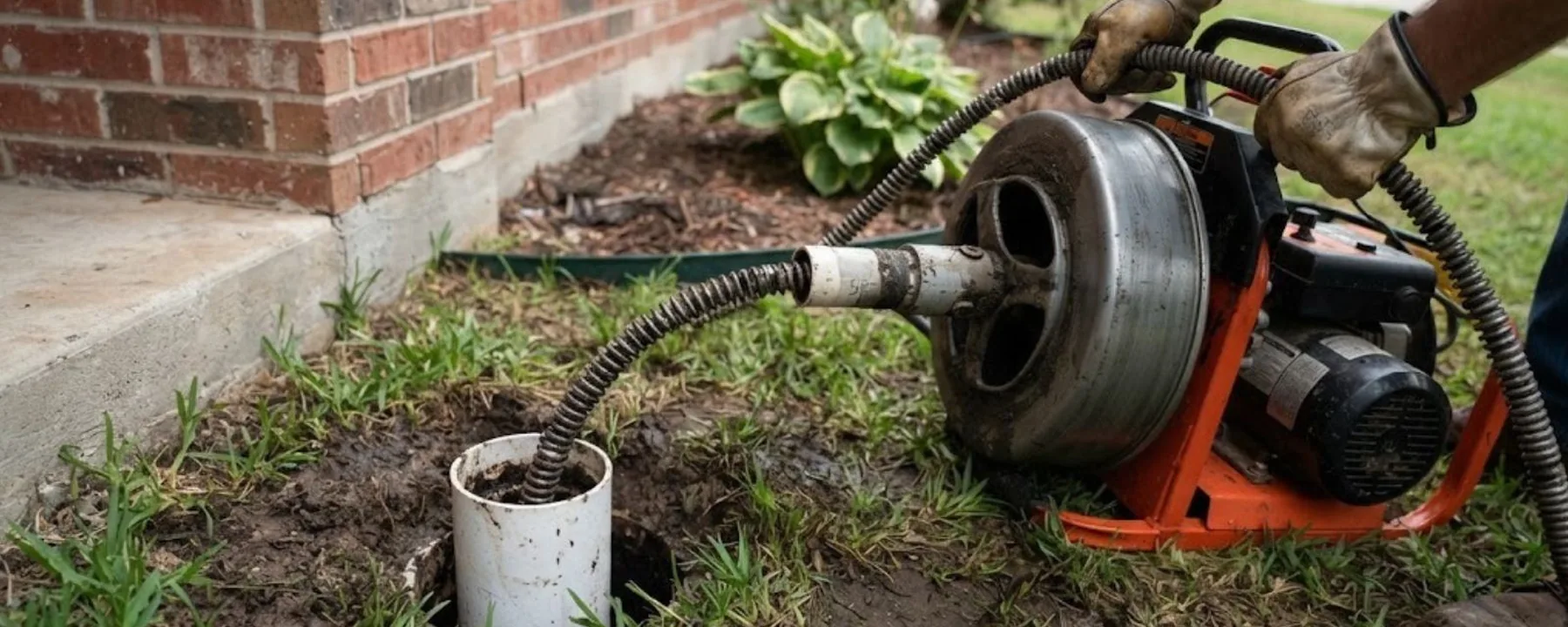
A blocked sewer line sends wastewater back into the house through the lowest drain, and that is usually a basement floor drain or a tub. Stop using water now and call (215) 714-6692, since the line is open 24/7 and a dispatcher can tell you what to shut off while a plumber is sent. Sewer line cleaning clears the large pipe that carries all household waste out to the public main, using a cable, a water jet or both.
The first question is whether the problem is the main line or a single fixture, because the fix, the tool and the urgency are different.
Main line or one fixture? Read the signs
This table sorts the most common symptoms. If your house matches the first three rows, assume the main line until a plumber says otherwise.
| What you notice | What it points to | What to do first |
|---|---|---|
| Basement floor drain bubbles or fills when a toilet flushes | Main line blockage | Stop all water use and call right away |
| Toilets, tubs and sinks all slow or gurgling together | Main line, or the shared stack just before it | Stop all water use and call, see drain cleaning for single-fixture cases |
| Water backs up in the lowest tub when the washer drains | Main line or the branch feeding it | Hold laundry and call |
| Sewer smell in the yard and a wet patch over the lateral | Break or leak in the buried pipe, not just a clog | Call, a camera look comes first, see sewer inspection |
| One sink or one tub is slow, everything else is fine | Trap or branch for that fixture | Try a plunger, then call if it does not clear |
Patterns, not a diagnosis. A plumber confirms with a cable or camera.
Sewage coming up in the house right now: what to do first
Sewage in living space is a health issue as well as a plumbing one. These steps keep it contained while help is on the way.
Stop all water use
Turn off the washer and dishwasher, skip showers and do not flush. Every gallon sent down adds to what is coming back up.
Keep people out of the affected area
Keep children and pets away from standing water. Wear boots and gloves if you must cross it, and wash well afterward.
Stay clear of electrics
If water reaches an outlet, a furnace or a panel, do not touch them. Tell the dispatcher so the plumber can plan around it.
Move what you can
Lift boxes, rugs and electronics off the basement floor and take photos of the water for your insurer.
Call the plumber, and the Township if neighbors are backed up
Call (215) 714-6692 first. If the blockage seems to be on the street side, Abington Township takes sewer backup calls at 215-884-8329. After-hours calls are answered, and same-day appointments are offered when available.
Drains backing up into the basement?
Stop using water and call. A dispatcher is on the line at any hour.
What blocks a sewer line: roots, grease, wipes and age
Abington Township's wastewater page lists the three biggest causes in one word, FROG, which stands for fats, roots, oil and grease. Roots find a tiny gap at a joint and grow into the pipe looking for moisture. Grease cools and coats the walls, and wipes and paper towels snag on the rough spots until a plug forms.
The housing stock makes all three more likely. The median home in the township was built in 1956, and about 61 percent of its 23,232 homes predate 1960, per Census American Community Survey estimates for 2020 to 2024. Lines from that era are often clay or cast iron with many joints, and each joint is a place for roots to enter.
If you live in an older part of Jenkintown or Glenside, expect the same pattern. A line with roots or scale that has been cleared more than once is a good candidate for a camera look, because the camera shows whether you need maintenance cleanings or a repair.
Township main or your lateral: who handles what
Abington Township owns the public sewer main and the treatment plant on Fitzwatertown Road. The Township's page says the pipe from your house is connected directly to the main, and that if the blockage is between the house and the main, residents should contact a plumber. Where exactly the Township's responsibility starts is not spelled out in an ordinance we could find, so ask the Township if you are unsure.
Abington Township Wastewater Utilities
- Runs the public sewer main and treatment plant
- Takes sewer backup calls at 215-884-8329
- Handles problems found in mains and manholes
- Can tell you if neighbors are reporting the same backup
A licensed plumber
- Clears the pipe inside your house
- Clears the blockage between the house and the main, per the Township's guidance
- Runs a camera to find where the problem sits
- Repairs the pipe when cleaning is not enough
Clearing the line, from cleanout to camera
Locate the cleanout
Most houses have a capped cleanout near the main drain in the basement or at the edge of the foundation. If there is none, a toilet may have to be pulled.
Cable the blockage
A powered cable with a cutting head goes in first to open the line and chop roots. It tells the plumber how far in the blockage sits.
Jet if the pipe allows
On a sound pipe, hydro jetting washes the walls and carries out grease and silt. If the cable stopped short, the plumber looks first.
Run a camera
A sewer camera shows roots, cracks, offsets and bellied sections, and confirms the line is open.
Explain what was found
You hear whether this was a one-time clog, a root problem that will return or damage that needs sewer line repair.
Backups that only show up in heavy rain
If the basement drain backs up mainly during storms, the cause may be rainwater entering the sewer system, not a blockage in your pipe. The Township's wastewater page notes that sewers take on extra water in wet weather, and it says sump pumps must be piped out of the house and never connected to the sanitary sewer.
The Township's FAQ also suggests a check valve on basement drains. Whether one fits your plumbing is a question for a plumber and the Township, so ask. A failing sump pump can also leave water in the basement without any sewer problem at all.
What to tell the dispatcher when you call
A short, clear description lets the right equipment arrive. Gather these before dialing if you can do it safely.
- Which drains are affected Name them. A floor drain and a tub that back up together tell us more than a general slow house.
- When it started Say whether it began after laundry, a heavy rain or a flush. Timing helps separate a clog from a storm problem.
- Whether neighbors are affected A shared problem on the street points toward the Township's main. A single house points toward your own lateral.
- What has been tried Mention any plunger, drain chemical or earlier cable visit, so the plumber does not repeat it.
- Where the cleanout is If you know it, say so. If you have never seen one, tell us that too.
What shapes the price of cleaning a sewer line
A sewer line is long, buried and different in every house, so the price is set after the plumber sees how it is reached and what is in it. You get a clear price before work starts.
Sewer backup damage is often covered only if your homeowner policy has a backup add-on, so read yours or call your insurer. Call (215) 714-6692 to hear how same-day scheduling looks tonight.
Call for your priceWhen cleaning is not enough
A line that backs up again within weeks of cleaning, a cable that stops at the same spot every time or a camera view of cracked or bellied pipe all point to repair. Sewer line cleaning opens the pipe and does not fix a broken one, so we will say so before suggesting anything more.
Sewer line cleaning questions from Abington homeowners
Yes. The dispatch line is open 24 hours a day, every day, including holidays. If sewage is coming up at 2 a.m., call, tell us which drains are affected and we will say what to stop using while a plumber is sent.
Several fixtures slowing or gurgling together, or a basement floor drain bubbling when a toilet flushes, point to the main. A single slow sink or tub usually points to its own trap or branch line.
Call a plumber for a clog inside the house or between the house and the main. Abington Township's Wastewater Utilities Department takes sewer backup calls at 215-884-8329, which is worth doing if neighbors are backed up too.
In older clay and cast iron lines, yes. Roots enter at joints and cracks looking for moisture. Cutting them gives temporary relief, and a camera shows whether the pipe needs repair to stop them from returning.
Not exactly. Sewer line cleaning is the goal, and it can be done with a cable, a water jet or both. Jetting is often chosen for grease and scale, as long as a camera shows the pipe can handle it.
Stop using water, including the washer, dishwasher and toilets. Keep people and pets out of affected rooms, stay away from electrics near water and photograph the damage for your insurer.
Many policies cover water backup only with a specific add-on or endorsement. Policies differ, so read yours or call your insurer. Take photos before cleanup and keep any paperwork from the plumber.
It depends on the pipe, the trees nearby and your household. A line that has had roots or repeated clogs may benefit from scheduled cleaning, while a clear line may not need any. The camera pass tells the plumber which you have.