
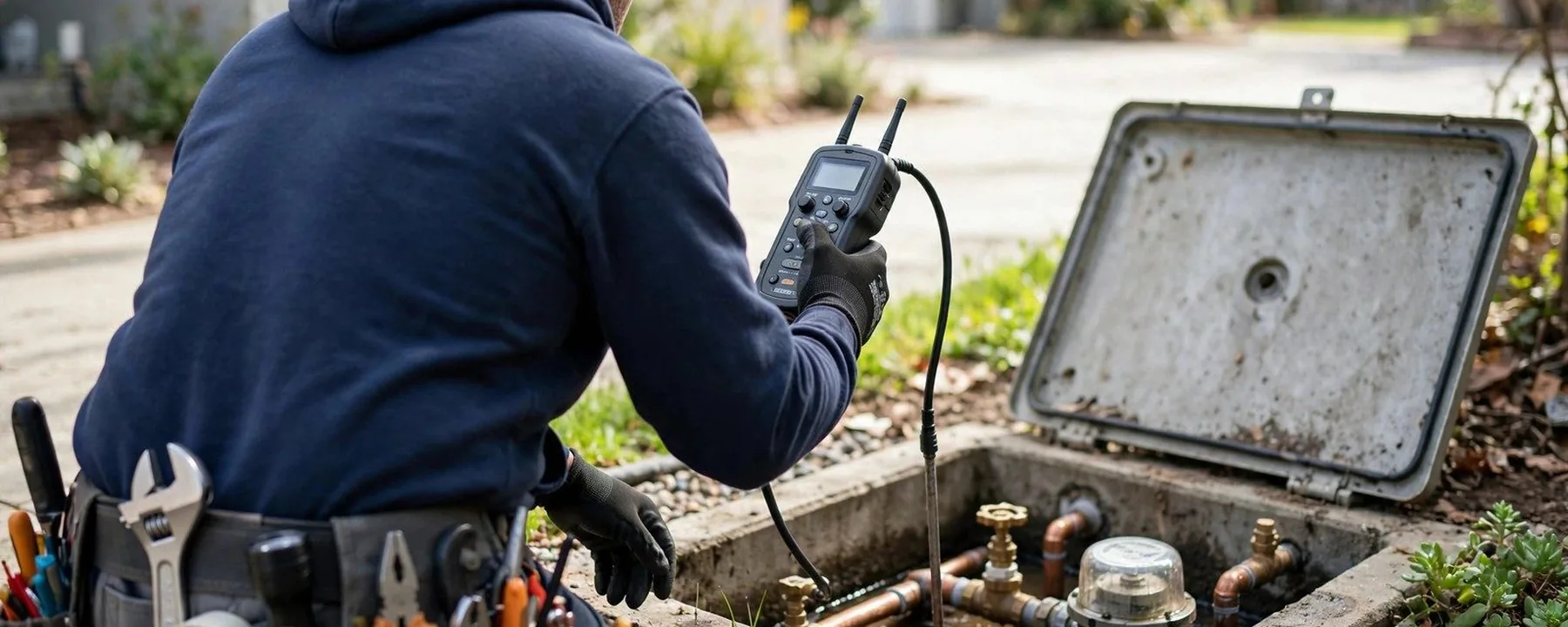
Your meter keeps turning when every tap is closed, the water bill jumped, a patch of floor feels warm or a ceiling stain grows by the hour. Leak detection is the work of finding exactly where water is escaping from a pipe, usually without opening more wall or floor than needed. If water is visible and moving, close the main valve first and then call (215) 714-6692, because the line is answered 24/7.
While you wait, keep outlets and electronics clear of the wet area and photograph the meter dial. Please do not cut into drywall to look for the source. A hole in the wrong place adds repair work and rarely shows the leak.
Six ways a hidden leak shows itself
The meter moves with every fixture off
A dial or flow triangle that turns while nobody is using water is the clearest sign. The next section shows the check that Aqua itself recommends.
A bill that climbs for no reason
If the household did not change and the bill did, a slow leak or a toilet that keeps refilling is a likely cause.
A warm patch on the floor
Warmth under tile, vinyl or carpet often means a hot water line is leaking beneath it, and the heat travels along the slab or subfloor.
A ceiling stain or bubbling paint
Brown rings, sagging drywall and blistered paint mean water has been present for a while, and the source may sit several feet away.
A hiss, drip or trickle inside a wall
Running water sounds are easiest to hear at night. A steady hiss usually means a pressurized line, while a drip may be a joint or a drain.
A soggy strip of lawn or a sudden pressure drop
Wet ground in dry weather, or weak flow at every tap, can point to the pipe between the street and the house.
Water meter and high bill: the two-hour check
Start at the water meter, because it measures every drop that enters the house. Aqua Pennsylvania's customer guidance says to choose a two-hour window with no water use, read the meter before and after, and treat any change as a likely leak. The check costs nothing and takes a few minutes of your time.
Stop every use of water
Close all taps, pause the dishwasher and washer, and check that the ice maker and humidifier are not filling.
Read and photograph the meter
Write down the digits or snap a photo with the time. Many meters also show a small triangle or wheel that spins whenever water moves.
Wait two hours, then read it again
A changed reading means water went somewhere. If the triangle is spinning, you do not even need to wait.
Close the main valve and look again
If the dial stops, the leak is usually inside the house. If it keeps moving, the leak is often on the buried stretch between the meter and the main valve, covered further down this page.
Aqua does not offer leak adjustments in Pennsylvania
Aqua's leak adjustment page lists several other states and says plainly that it does not offer leak adjustments in PA. A leak that runs for a whole billing cycle is therefore a cost the household carries, which is the strongest reason to find one early. For questions about your meter or your account, Aqua customer service is at 877-987-2782, and the meter itself belongs to Aqua even though the plumbing in an outdoor meter pit is the customer's.
Ceiling and wall leaks: finding the source behind the stain
A stain is where water came out, not where it started. Water follows joists, pipes and the back of drywall before it soaks through, so a ceiling spot can sit several feet from the failed joint. A stain that grows when nobody has used the bathroom points toward a pressurized supply line. One that appears only after a shower points toward a drain, a tub seal or a shower pan.
A plumber usually begins with a moisture meter, which reads dampness through the surface, and may add a thermal camera that shows cooler or warmer patches behind drywall. Listening gear can pick up the sound of a pinhole spray inside a cavity. The aim is a single small access hole in the right place, which is cheaper to patch than a wall opened at random.
Not every ceiling stain is a plumbing leak. Roof leaks, condensation on cold ductwork and clogged air conditioner drain lines look much the same, so the plumber will often shut the water off and watch whether the stain stops growing. If you see water actively spraying, treat it as a burst pipe and shut off the main before anything else.
Under the house and in the crawl space
Most older houses here have basements, but additions, porches and some newer sections sit over crawl spaces. Leaks in those spaces can run for months because nobody goes down to look. Signs include a musty smell, sagging insulation, soft subfloor, mold on joists and a floor that feels spongy near a bathroom or kitchen.
The plumber will usually inspect supply lines, drain connections and the underside of tubs and toilets by flashlight, then pressure test the supply side if no wet joint is visible. Supply lines made of galvanized steel or early copper often fail at fittings. When several joints are weeping, the honest conversation is about replacing the run rather than patching each one, and the repiping page explains that path.
Underground and buried line leaks
The pipe that brings water from the street runs underground for tens of feet, and a leak there can go unnoticed for a long time. The tell-tale signs are a wet or unusually green strip of lawn, a soft spot in the driveway, a meter that keeps moving after the main valve is closed, or a sound of running water where the line enters the basement.
Ownership matters here. Aqua's published guidance says the company owns the line from its main to the curb, and the customer owns and maintains the portion from the curb stop to the building. A leak on the street side belongs to Aqua, so call 877-987-2782 after you confirm where the wet ground is. A leak on the house side is yours to fix, and the full process is on the water service line repair page.
Acoustic listening on the exposed pipe and on the ground above it, plus a pressure test of the line, can narrow the leak to a few feet. That matters because digging the whole yard is expensive and slow. Pennsylvania law asks anyone digging to call 811 at least three business days ahead so buried utilities are marked.
Water going somewhere you cannot see?
Call now, day or night. A dispatcher can talk you through the meter check and set up a same-day visit when available.
How plumbers find leaks without guesswork
No single tool solves every case, so the method depends on where the water is and what the pipe is made of. These are the common ones, and a plumber will pick from them based on what is on site.
| Method | What it helps find | Where it falls short |
|---|---|---|
| Meter and pressure test | Whether a leak exists and whether it is on the supply side | Does not say where the leak is, only that it is there |
| Acoustic listening | Pressurized leaks in walls, slabs and buried lines by their sound | Noisy plumbing or plastic pipe can muffle the signal |
| Thermal imaging | Hot water lines and wet areas that change surface temperature | Works best on warm leaks and open surfaces |
| Moisture meter | Dampness inside drywall, subfloor and baseboards | Shows wet areas, not the exact pipe |
| Tracer gas, where the plumber has it | Slow or hard-to-hear leaks in sealed lines | Not every plumber carries the equipment, so ask when you call |
| Camera inspection of drains | Drain and sewer leaks, cracks and offset joints, see sewer camera inspection | Only covers drain pipe, not pressurized supply lines |
Equipment varies by plumber and by job. Ask which methods will be used before work starts.
Slab leaks
A slab leak is a leak in a pipe that runs in or under a concrete floor. It is less common in houses with full basements but turns up in additions, garages and homes built on slabs. The warning signs are a warm spot on the floor, the sound of running water with no fixture open, a meter that moves, and damp carpet or floor tile that lifts at the edges.
Detection usually combines a pressure test on the hot and cold lines separately, acoustic listening and a thermal scan of the floor. Once the leak is found, the options are breaking the slab at that spot, rerouting the line through walls or the attic, or replacing the line. Rerouting costs more now but avoids reopening the floor, and a worn line with repeated leaks often leans toward a new run.
Housing age and why leaks hide in Abington walls
The median home in Abington Township was built in 1956, and about 61 percent of the 23,232 homes predate 1960, according to Census American Community Survey estimates for 2020 to 2024. Houses that old often combine original galvanized pipe, early copper with soldered joints and later repairs from several eras. When one joint leaks, the pipe beside it is often the same age.
That is why a good leak call ends with a question about the pipe on both sides of the fix. Older streets around Glenside and Jenkintown share this vintage, so the advice applies there too. Ask what material was found, how far the plumber looked in each direction and whether the nearby pipe shows the same wear.
What to do when a leak is an emergency: water on the floor tonight
An active leak that soaks a floor or drips toward a panel is a same-day call whenever the line is open, and it is open at night and on weekends. A slow hidden leak can wait for the next available appointment, but not for weeks. These steps keep the damage down in the meantime.
Shut off the main if water is visible
The main valve usually sits where the line enters the house, near the meter. Turn it clockwise until it stops.
Photograph the meter dial
A photo with the time gives the plumber a baseline and shows how fast the water is moving.
Keep power away from water
If water is dripping toward an outlet, light or panel, stay clear and tell the dispatcher on the call.
Dry what you can reach
Move rugs, furniture and electronics off wet floors and soak up standing water so it does not travel.
Note when it started
A date for the first stain, sound or bill change helps the plumber work out whether the leak is old or new.
Sprinklers, pools and the box at the curb
Irrigation systems leak at valves, heads and buried joints, and the signs are a soggy lawn after a watering cycle or a meter that moves when the zone runs. Shut the system off at the controller and check whether the meter stops. If it does, the leak is on the irrigation side, which the plumber can locate by testing one zone at a time.
Pools and spas lose water through returns, skimmer lines and buried plumbing, so the first step is to separate normal evaporation from a real leak. A bucket test or a pressure test on the lines will usually tell the difference. Leaks at the meter box or curb stop show up as a wet patch or standing water in the box itself, and the owner of the leaking part decides who fixes it.
What decides the price of finding a leak
A fair quote for detection depends on how hard the leak is to find, not just how many tools show up. You get a clear price before work starts, and these are the factors that move it.
Many homeowner policies cover sudden water damage but not a slow leak that went unnoticed, so photograph everything and ask your insurer early. Want a number for your house? Call (215) 714-6692.
Call for your priceWhat you can check yourself and what to leave to a plumber
Reasonable to do on your own
- Run the two-hour meter check
- Look for dripping toilets with a few drops of dye in the tank
- Check under sinks and behind appliances
- Close the main and sprinkler valves
- Photograph stains and the meter
Leave to a licensed plumber
- Pressure testing supply lines
- Listening and thermal scans for hidden leaks
- Opening walls or floors to reach a pipe
- Anything on the buried line from the curb
- Deciding between a patch and a replacement
Leak detection questions from Abington homeowners
Yes. The dispatch line is answered 24 hours a day, every day, and a leak that is flooding a floor or soaking a ceiling is treated as urgent. Call, describe what you see and give your address, and we will tell you how to stop the water while a plumber is sent.
Shut off every tap and appliance, read the meter, wait two hours, and read it again. Aqua Pennsylvania says a changed reading likely means a leak. If the meter moves, close your main valve and look again to see whether the leak is inside the house or on the line outside.
Aqua's leak adjustment page lists adjustments for other states and says it does not offer them in Pennsylvania. Ask Aqua customer service at 877-987-2782 about your own account, since billing rules can change and a representative can see your usage history.
A plumber usually starts with the meter and a pressure test, then narrows the area with acoustic listening, a thermal camera and a moisture meter. The result is often one small access hole in the right place. Some leaks still need more than one visit.
Yes. Leaks inside walls, under floors and underground can run without any visible sign. A high bill, a moving meter, a warm floor patch or a hissing sound are the clues that something is wrong even when the surface looks dry.
Under Aqua's published guidance, the company owns the line from its main to the curb and the customer owns and maintains the line from the curb stop to the building. Finding which side of the curb stop the leak sits on decides who repairs it.
Yes, using pressure testing on the hot and cold lines, acoustic listening and thermal scanning where it applies. Once the spot is found the plumber will explain whether to break the slab, reroute the line or replace it.
It can. A worn flapper or fill valve can waste water all day without any sound, and the meter will show it. A few drops of food coloring in the tank will reveal whether color reaches the bowl without flushing.