
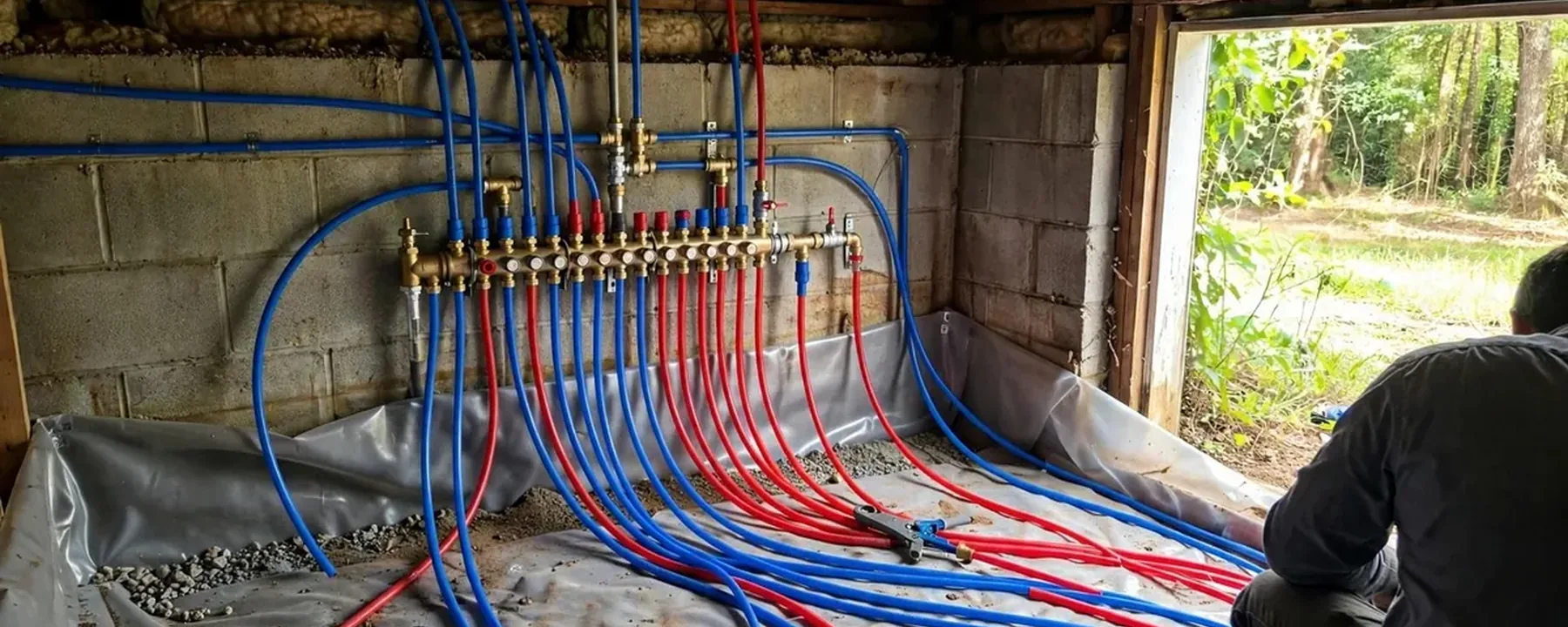
Repiping is the replacement of a house's water supply pipes, either all of them or one branch at a time. In Abington, where most homes were built before 1960, the question usually starts with something the house is already telling you. The table below matches the common signs to what they suggest and whether a repair or a repipe is the usual answer.
These are patterns, not a diagnosis. A plumber has to look at the pipe itself before anyone can say which row your house belongs in.
| What the house is telling you | What it often suggests | Repair or repipe? |
|---|---|---|
| One leak at a single joint, pipe otherwise sound | A failed fitting or a bump from other work | Repair |
| Second or third pinhole leak in the same line | Pipe wall thinning along its length | Repipe that line, or the whole house if other lines match |
| Weak flow at every tap, strong flow at the meter | Mineral and rust buildup narrowing the inside of old pipe | Repipe, after the plumber rules out a closed valve or a regulator problem |
| Rust-brown water that clears after running | Corroding steel pipe shedding rust | Repipe if the pipe is galvanized, flush and test if it is not |
| Pressure drops when two fixtures run at once | Narrowed galvanized lines or a partly closed valve | Check valves first, then consider repiping |
| Green crust or pinhole weeps on copper | Pitting from water chemistry or poor early joints | Repair a spot, repipe a run if it keeps coming back |
| Leak behind a finished wall after a prior repair | Aging pipe around the earlier fix | Ask about replacing the whole run while the wall is open |
A plumber can read your pipe material in a few minutes. Ask to see it rather than taking a guess.
Low pressure, rusty water and pinhole leaks that keep coming back
Most people do not call asking for a repipe. They call because the shower has gone weak, the water runs brown for a minute each morning, or a stain has shown up on the ceiling below the bathroom for the second time. Those three problems share a cause more often than you might expect.
Low pressure at every faucet while the street pressure is fine usually points to the inside of the pipe. Galvanized steel builds up rust and mineral scale on the inside wall, and the opening shrinks until a full-size pipe behaves like a narrow one. Brown water is the same corrosion breaking loose, and pinhole leaks are where the pipe wall finally gives way.
Before anyone talks about replacing pipe, the plumber should rule out the cheap causes. A half-closed main valve, a failing pressure regulator, clogged faucet aerators and a problem on the line from the street can all mimic a pipe in decline. If the street line is the culprit, the fix belongs on the water service line repair page, not in your walls.
If the cheap causes are cleared and the symptoms are still there, ask the plumber to show you a cut section or an exposed length of pipe. Seeing the scale inside a sample tells you more than any estimate.
Why so many Abington houses reach this point together
The median home in Abington Township was built in 1956, and about 61 percent of the 23,232 homes predate 1960, according to Census American Community Survey estimates for 2020 to 2024. About 19 percent were built in 1939 or earlier. Houses from the 1940s and 1950s were often plumbed with galvanized steel or early copper, and original supply lines in that age range are now past the point where they were expected to last.
Source: U.S. Census Bureau, American Community Survey 5-year estimates for 2020 to 2024, tables B25034 and B25035. Estimates carry a margin of error.
What the housing numbers mean for your pipes
A house from 1956 may have been repaired, re-plumbed in part or fully replaced since, so age alone proves nothing. What the numbers do tell you is the odds. If you bought a house from this era and no one can tell you when the supply lines were last touched, assume you have mixed materials until a plumber confirms otherwise.
A quick check costs little. Look at the pipes where they leave the water meter and run along the basement ceiling. Gray, threaded steel pipe is galvanized, brown or copper-colored pipe is copper, and flexible plastic in white, red or blue is PEX. Many Abington basements show all three because earlier owners repaired one problem at a time, and that patchwork is exactly the case where a plan for a partial repipe pays off.
Neighbors in Glenside, Jenkintown and Elkins Park share much of this housing vintage, so the same checks apply across the older parts of the area.
Not sure whether your pipes need replacing?
Describe what you see and a dispatcher will tell you what to check. The line is open at any hour.
Replacing galvanized pipe
Galvanized steel is iron pipe coated in zinc. The coating protects it for a few decades, but once it wears through, rust forms inside and the pipe slowly clogs while it corrodes. The threaded joints are usually the first place it fails.
Galvanized replacement is the most common repipe job in older neighborhoods. The plumber removes the steel and runs new pipe, typically copper or PEX, from the shutoff to each fixture. Because galvanized is often mixed with copper after past repairs, the plumber also checks the points where the two metals meet, since dissimilar metals can corrode faster at a joint.
If your pipe is galvanized and you have had one leak, the realistic question is when to replace it, not whether. Waiting until a wall is soaked means paying for a repipe and for the repairs to the wall. Planning it on your schedule usually costs less in total, and it lets you choose when the water goes off.
Whole-house repipe or only part of it
Replace only the failed branch
This suits a house where one line is bad and the rest checks out as sound copper. It costs less now, but you accept that older pipe elsewhere may be next.
Replace the basement mains and risers
Swapping the large trunk lines and the vertical runs first restores pressure for the whole house. Branch lines to a few fixtures can wait.
Repipe the whole house
This makes sense when galvanized runs through most of the house or leaks have shown up in several rooms. You pay once, open walls once and finish with one material.
Stage it over a few visits
Some owners do the kitchen and bath first and the rest later. Staging spreads the cost but means more days with the water off and more patching.
Repipe before a remodel
If a kitchen or bath gut is planned, the walls are already open. Replacing pipe in that moment saves the cost of cutting them twice.
PEX or copper for a repipe
Both materials are widely used in homes, and either can be a sound choice. The plumber's preference, access to the walls and your budget usually decide it more than any single technical edge.
PEX is flexible plastic tubing that snakes through walls with fewer joints, which often means less demolition and a shorter job. Copper is rigid, has a long record in homes and is familiar to most inspectors and buyers. Copper typically takes more cuts and fittings, and soldered joints take longer to make.
Water chemistry, local practice and how a house is laid out all influence the choice, and some water conditions are tougher on copper than others. Ask the plumber why they favor one material for your house, and ask what warranty comes with the pipe and with the labor. If the answer is just a brand name, keep asking.
What living through a repipe looks like
A repipe is disruptive but short compared with how it feels. Ask the plumber for the plan in writing so you know what happens each day.
Plan around the water shutoff
Water is off for stretches while the old lines come out and the new ones go in, often for part of a working day. Fill containers for drinking, flushing and washing before the crew arrives, and ask when the water will be back on at the end of each day.
Clear the access paths
Move furniture and belongings away from the basement ceiling, the closet or cabinet under each fixture and any wall the plumber needs to reach. Cover floors and keep pets out of the work area.
Expect access holes in walls
Where pipes run inside finished walls, the plumber cuts small openings in the drywall or plaster to pull new lines through. Good crews plan these holes to stay small and in places that are easy to patch, such as the back of a closet.
Test and flush the new lines
After the pipe is in, the plumber pressure-tests the system and flushes it so debris leaves through a spigot, not your faucets. You should see no new drips at the joints before anything is closed up.
Hire the patching separately
A plumber opens walls and may close them up only in a rough way. Drywall finishing, plaster repair and paint are separate trades, so ask who handles them and whether that is in your quote.
What decides the price of a repipe
No honest repipe price can come from a phone call. You get a clear price before work starts, and these are the factors that move it.
Wall repair, paint and permit paperwork may be part of the quote or priced separately, so ask. Some homeowner policies cover a sudden pipe failure but not the pipe replacement itself, so check yours if a leak started the conversation. Ready for your own number? Call (215) 714-6692.
Call for your pricePermits and who can pull them
Plumbing work that replaces pipe generally needs a township permit, and the details depend on the job, so ask Abington Township's Community Development office what applies to yours. Abington's published rule is that plumbing permit applications come from a master plumber registered with the township. In practice that means your plumber, not you, should handle the application, and you can ask to see that it was filed before the walls are closed.
New construction plumbing and additions
Rough-in plumbing for a new addition or a rebuilt house is a different job from replacing old lines, but the same materials choices apply. The supply pipe is installed before drywall goes up, inspected, then connected to fixtures at the end. If you are planning an addition, talk to a plumber early about where the new bath sits relative to your existing lines, and see plumbing installation for fixture and gas-line work.
Repiping questions from Abington homeowners
Galvanized pipe is gray and dull with threaded joints at the fittings. A magnet will stick to it, and a scratch shows silver metal. Copper looks brown or orange and PEX is flexible plastic, so a look in the basement usually settles it.
It depends on how much of the pipe is worn. If one line is bad and the rest is sound, a partial repipe can make sense. If galvanized runs through most of the house, replacing all of it avoids opening walls twice.
Both work well in homes. PEX bends through walls with fewer joints and often means less demolition, while copper is rigid and has a long track record. Ask your plumber why they favor one for your house.
Timing depends on the size of the house and how easy the pipes are to reach, so a plumber has to see it first. The water is usually off for part of each work day, not the entire job.
A plumber cuts the access holes, and drywall finishing, plaster repair and paint are usually separate trades. Ask before the job starts who handles patching and whether it is included in the quote.
Ask Abington Township's Community Development office what applies to your project. The township says plumbing permit applications come from a master plumber registered with the township, so your plumber normally files it.
Brown water that clears after a minute often means rust loosened inside old steel pipe. It can also come from work on the water main. If it happens only at certain taps or comes back every day, have the pipes checked.
Sometimes not. If the pipe is otherwise sound, a repair may be enough. If the pipe is galvanized or old and one pinhole has appeared, more usually follow, so ask the plumber to inspect the whole run.