
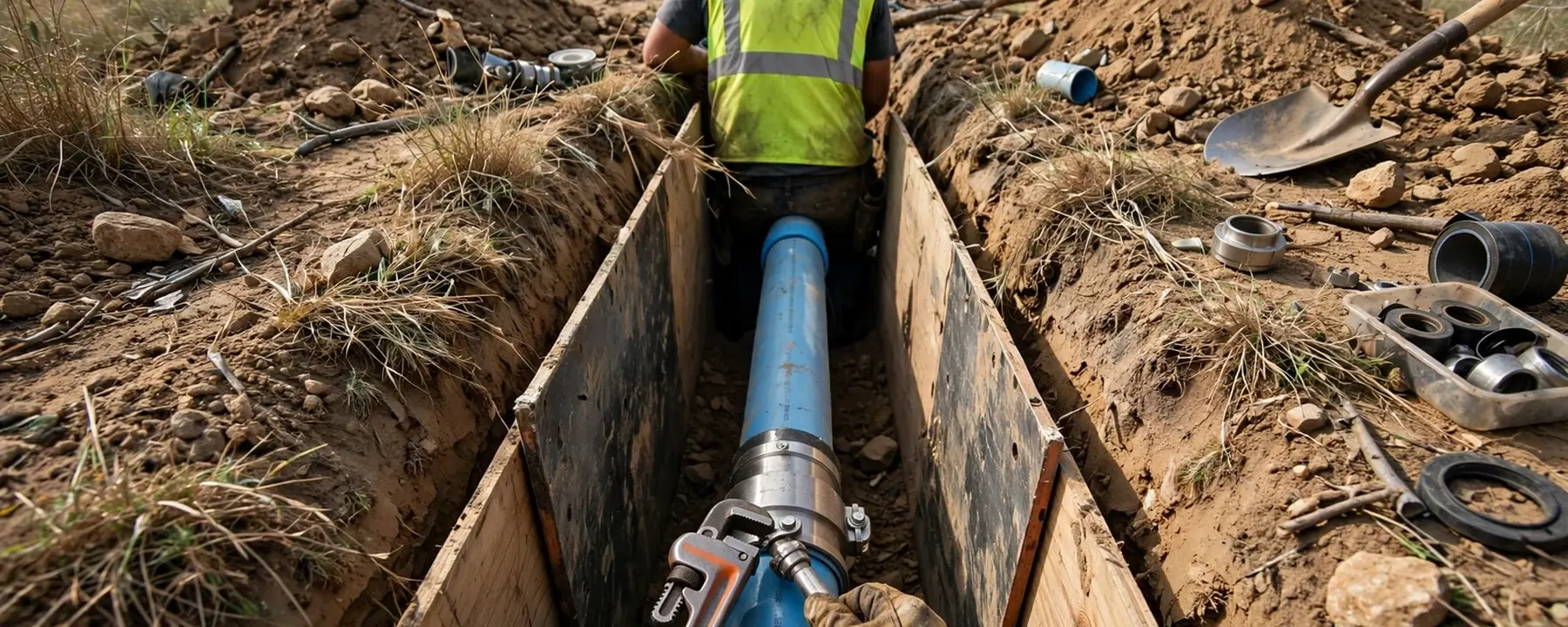
Before anyone digs, one question decides who fixes the pipe. Aqua Pennsylvania owns the water service line from its main in the street to the curb, and the customer owns and maintains it from the curb stop to the building. If water is rushing in your yard or basement now, close your main valve and call (215) 714-6692, because the line is answered around the clock.
The curb stop is a shutoff valve in a small cover near the street, often in the lawn or sidewalk strip. A problem on the street side of it is Aqua's to repair, and one on the house side is yours. A pipe that fails after the meter inside the house is usually a burst pipe and follows a different path.
Who owns which stretch of the line
The ownership split comes from Aqua's own customer guidance and its lead service line fact sheet. Knowing it before you call saves a day of phone tag.
| Segment | Who owns and maintains it | Who to call |
|---|---|---|
| Water main in the street | Aqua Pennsylvania | Aqua customer service at 877-987-2782 |
| Main to curb stop | Aqua Pennsylvania | Aqua customer service at 877-987-2782 |
| Curb stop to the building | The customer | A licensed plumber, at (215) 714-6692 |
| Meter | Aqua owns the meter, and the customer provides a suitable location and keeps an outdoor pit visible | Aqua for the meter, a plumber for the pit plumbing |
| Pipe after the meter inside the house | The customer | A licensed plumber, at (215) 714-6692 |
If you are unsure where the curb stop is, say so on the call. A plumber can locate it and confirm which side the leak is on.
Signs the leak is on the line from the street
The meter runs with the house shut down
Close every tap, then close the main valve. A meter that keeps moving points to the stretch between the meter and the valve, or to the line outside. The leak detection page walks through the two-hour check.
A wet or unusually green strip of lawn
Water pushing up through the soil in dry weather usually follows the path of the buried pipe.
A soft spot in the driveway or sidewalk
Leaking water can wash soil from beneath paving, leaving a dip or crack above the line.
Wet basement wall where the line enters
Water appearing at the entry sleeve can mean the line has failed just outside the foundation.
The sound of running water near the meter
A hiss or rush at the entry point with every fixture off is a strong clue.
A bill that rises with no change at home
A steady buried leak adds up over weeks because nothing in the house shows it.
When a water line is an emergency: water pouring in tonight
A line leaking into a basement or washing out a yard is a same-day call, and the dispatch line is open after hours. Water pressure on a service line is steady, so the flow will not slow down by itself.
Close your main valve
It is usually inside the basement wall where the line enters. Turn it clockwise until it stops.
Check the meter and the ground
If the meter still moves, the leak is before the valve. Note where the ground is wet and take photos.
Do not dig or probe the yard
Buried gas, electric and communication lines may share the area, and digging has its own rules covered further down this page.
Protect the basement
Move belongings off the floor, keep the sump pump running and stay clear of the electrical panel if water is near it.
Call Aqua if the wet spot is by the street
If water is coming up near the curb, the leak may be on Aqua's side. Aqua customer service is 877-987-2782, and a plumber can confirm.
Water coming up in the yard or basement?
Close the main and call. A dispatcher is on the line at any hour and can help you work out which side of the curb stop it is on.
Low pressure: when the service line is the cause
Weak flow at every tap, or pressure that fades when two fixtures run, can come from the service line. A leak steals water before it reaches the house, and old galvanized steel narrows from rust until little water passes. A partly closed valve, a failing pressure regulator or a clogged fixture can cause the same symptom, so the plumber will rule those out first.
A simple clue is where the weakness shows up. If only one faucet is weak, the cause is probably that fixture or its supply. If every tap is weak, including the outdoor spigot, the problem is more likely at the main valve, the meter or the line itself. Tell the dispatcher which it is, and mention any rust-colored water, since that often goes with aging steel pipe.
A pressure gauge on a hose bib gives the plumber a number to compare against. A reading that drops when other fixtures open often points to a restricted line, while a steady low reading may point toward a regulator or a valve.
Repair or replace the line
The right answer depends on what the pipe is made of, how long it runs and how many problems it has had. A single clean failure is a different job from a line that is worn all the way along.
| What the plumber finds | Usual choice | Why |
|---|---|---|
| One leak on a sound, newer pipe | Spot repair with a new section and fittings | Cheapest path when the rest of the line is healthy |
| Corroded galvanized steel | Replace the line or a long section | Patching one joint often leads to another failure nearby |
| Lead pipe identified | Replace the customer-owned section, and ask Aqua about its program | Lead lines are being phased out, see the program section below |
| Repeated leaks on the same line | Replace the full customer-owned run | A new line stops the cycle of emergency calls |
| Leak found on Aqua's side of the curb stop | Aqua repairs it | Ownership rests with the utility, so call Aqua |
Trenchless or open trench
A trench replacement digs a path along the line, removes the old pipe and lays a new one. It is straightforward, lets the plumber see the whole pipe and often costs less in materials, but it disturbs lawns, walks and driveways. Trenchless methods, where a plumber has the equipment, use small entry and exit holes and pull or burst a new pipe through the old path.
Trenchless is not always available. It depends on soil, depth, bends, the existing pipe and what sits above the line, so the plumber has to inspect the route first. Ask what each option would disturb, what it would cost relative to the other and whether the new pipe will connect cleanly at the curb stop and at the meter.
Aqua's lead service line program for customers
Aqua Pennsylvania publishes a Customer Lead Service Line Replacement Program fact sheet specific to Pennsylvania. It describes replacing customer-owned lead lines at no direct cost to the customer under an access agreement, with a two-year warranty and a yearly cap that depends on Aqua's budget.
Eligibility, timing and any wait list are Aqua's to decide. Ask Aqua at 877-987-2782 and check its service line inventory at aquawater.com/leadmap before you pay for a replacement. If a leak forces an urgent repair, tell the plumber about the lead question so the old pipe is identified.
Before anyone digs: PA One Call and 811
Pennsylvania asks excavators to contact PA One Call at least three business days before digging begins. The call is free for residential property owners, and utilities mark their buried lines before the work starts.
Dial 811 or visit pa1call.org
Give the exact address and the area to be dug. Out-of-state callers use 1-800-242-1776.
Wait for the marks
Painted lines and flags show gas, electric, telephone and other buried lines. Do not dig until they appear.
Plan around the schedule
A planned replacement fits easily. If the break is urgent, the plumber will explain how the process applies and what can be done in the meantime.
Ask about the permit
The township's plumbing permit covers installing, replacing or modifying pipes, and the plumber confirms what applies with Community Development.
What decides the price of a service line repair
A line that is thirty feet long and shallow is a very different job from one that is longer, deeper and under a driveway. You get a clear price before work starts, and these factors move it.
Some homeowner policies cover water line breakdown as an add-on, and many do not, so check yours before you assume. Want a clear number for your house? Call (215) 714-6692.
Call for your priceWhat you can do yourself and what to leave to a plumber
Fine to do on your own
- Close the main valve inside the house
- Read and photograph the meter
- Find and clear the cover over the curb stop
- Call Aqua about the street side
- Call 811 before any planned digging
Leave to a licensed plumber
- Locating and testing a buried line
- Cutting or connecting new pipe
- Working at the meter or in the meter pit
- Deciding between spot repair and replacement
- Anything on Aqua's side of the curb stop
Older Abington lines and the pipe you cannot see
The median home in Abington Township was built in 1956, and about 61 percent of the homes predate 1960, according to Census estimates for 2020 to 2024. Service lines in houses that old can be lead, galvanized steel or early copper, and the material often matches what is found inside the basement. If the first foot of pipe at the entry is steel, ask what is buried outside.
Homeowners near Willow Grove and Jenkintown share this vintage, so the advice carries over. A service line replacement is also a good moment to look at the supply pipe inside, because new copper joined to old galvanized can leave a weak link. The repiping page covers that decision.
Water service line questions from Abington homeowners
Yes. The dispatch line is answered 24 hours a day, every day, including holidays. Call, say where the water is coming up and whether the meter is still moving, and we will tell you how to shut it off while a plumber is sent.
Under Aqua Pennsylvania's guidance, the company owns the line from its main to the curb and the customer owns and maintains the line from the curb stop to the building. The curb stop is the dividing point.
Aqua's fact sheet says customers must maintain and repair the customer-owned portion of the service line. A licensed plumber handles that part, while Aqua handles the stretch from its main to the curb.
Shut off every tap and check whether the meter still moves. Other signs include a wet strip of lawn in dry weather, a soft spot in the driveway, low pressure and a rising bill. A plumber can pinpoint the spot with listening gear and a pressure test.
Causes include a partly closed valve, a failing pressure regulator, corroded steel pipe and a leak on the service line. The plumber checks the simple ones first, then tests the line. Telling the dispatcher whether one tap or all taps are weak helps narrow it.
Aqua describes a Pennsylvania customer lead service line replacement program at no direct cost under an access agreement, with a yearly cap. Eligibility is Aqua's decision, so call 877-987-2782 before paying for a replacement.
Pennsylvania asks anyone excavating to contact PA One Call at least three business days before digging. The call is free for residential property owners. The plumber will explain how that applies to your job.
No. It depends on soil, depth, bends in the route and the state of the existing pipe, and not every plumber has the equipment. The plumber inspects the route first, then explains what each option would disturb.