
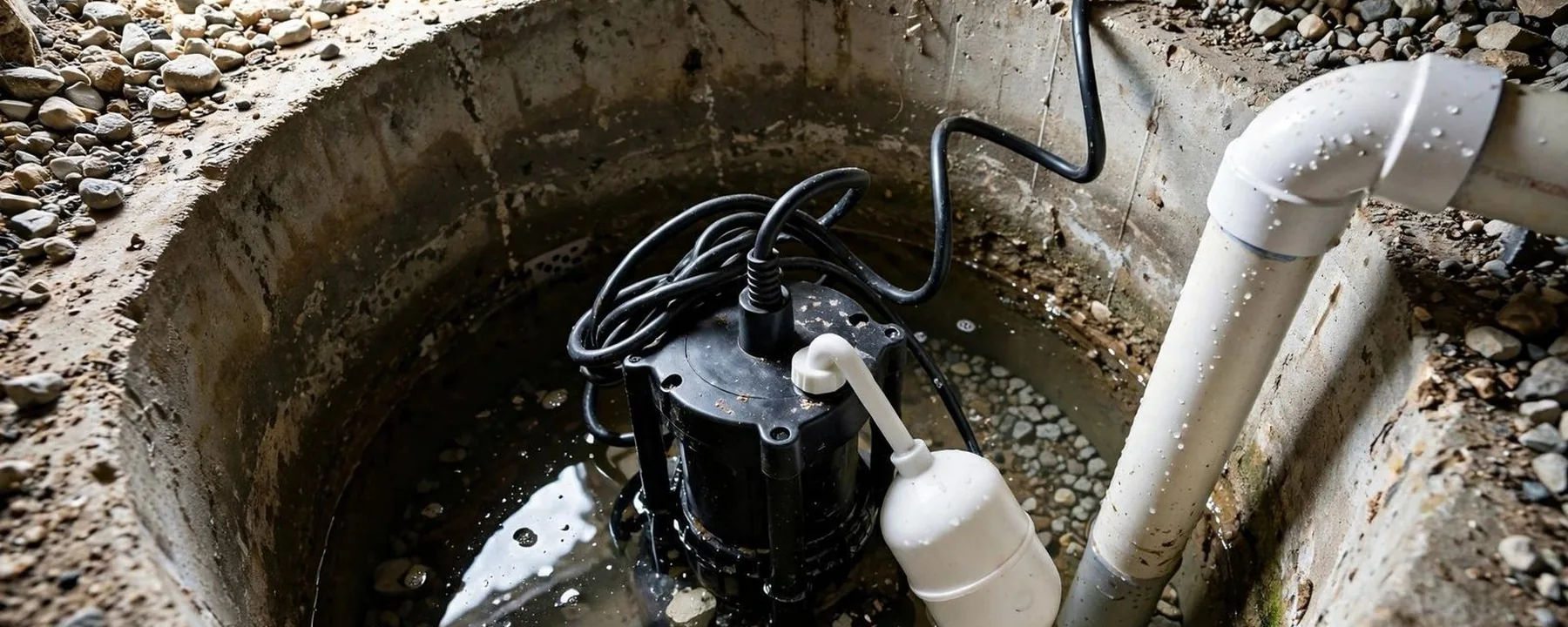
It is a storm night. The rain has come down for hours, and you walk downstairs to find the sump pump silent, or roaring without a break, or the pit water creeping up toward its rim. Emergency sump pump repair is the work of getting water out of the pit and away from the house again, whether that means freeing a stuck float, replacing a dead pump or fixing the discharge line.
Call (215) 714-6692 on our 24/7 line while you lift belongings off the floor. If the power is out, a pump without battery backup stops with the grid, and that is a frequent reason a dry basement floods in the middle of a storm. Stay out of water that reaches outlets or the panel, and tell the dispatcher whether the lights are on.
Sump pump not working? Match what you see to what is likely wrong
Callers describe the same handful of problems. Find yours below, and never reach into a pit while the pump is plugged in.
- Silent pump, full pit Check the plug and reset the GFCI outlet first, since a tripped outlet is the quickest fix. If power is fine, the float switch may be stuck or the motor may have burned out.
- Runs nonstop A float jammed against the pit wall, a failed check valve letting water fall back, or a blocked or frozen discharge line can all keep it running. It may also be keeping up with real groundwater.
- Hums but moves no water A jammed impeller or an air lock in the line can do this. The plumber can clear it or replace the pump if the motor is damaged.
- Cycles every few seconds Short cycling usually points to a bad check valve, a stuck float or a pit that is too small for the pump.
- Power is out A standard pump cannot run without electricity. A battery backup or a second pump on its own power supply is what keeps water moving.
- Loud grinding or rattling Worn bearings, gravel or debris in the pit can make the pump noisy. Noise is a warning, since a pump often fails soon after it starts.
What to do while water rises in the basement and you wait for us
Calls at two in the morning are normal in a storm. The dispatcher tells you whether a same-day visit is open, and these steps help in the meantime.
Keep clear of electricity
If water touches outlets, a power strip or the panel, do not step into it. Switch off a breaker only from dry ground.
Check the outlet and the float
Reset a tripped GFCI, and look at the float from above without touching the water. If it sits against the pit wall, tell the dispatcher.
Lift valuables off the floor
Put boxes, rugs and electronics on shelves or furniture. Photograph the damage before cleanup for your insurer.
Move the downspout water away
Make sure each downspout empties well clear of the foundation. A short extension can cut how much water reaches the pit.
Never hose the pit into a drain
Do not run a temporary hose into a floor drain or toilet. The township prohibits sump water in the sanitary sewer, and it can also overload the system.
Call and describe the pit
Tell us whether the pump is silent, humming or running, how high the water sits and whether you have power. That helps the right parts reach you.
Pump dead or water rising?
Keep clear of the water and call. A dispatcher answers at any hour, storm or not.
Battery backup, check valve and discharge line
A pump is only as good as the parts around it. Three of them decide whether the pump saves a basement or loses to the first long storm.
A battery backup keeps a second pump or the main pump running when the power fails. Batteries wear out and the system needs testing, so ask the plumber how to check it.
A check valve sits on the discharge pipe and stops water from running back into the pit after each cycle. Without one the pump restarts again and again, which wears it out faster.
The discharge line carries water out of the house and away from the foundation. It should run to a spot where water can drain, not toward a neighbor's wall, and it should not freeze or kink. NOAA 1991 to 2020 normals put the average last spring freeze near April 4 at the Philadelphia Northeast Airport station, so an exposed outdoor end can ice over in early spring storms.
Repair or replace: how the plumber decides
The plumber checks power, float, motor, pit and discharge before suggesting anything. The pairs below show how findings usually lead to a fix.
| What the plumber finds | Usual move | Why |
|---|---|---|
| Tripped GFCI or a loose plug | Reset or replace the outlet, then retest the pump | The pump itself may be healthy |
| A stuck or worn float switch | Reposition the float or replace the switch | A simple part can be the whole problem |
| A burned-out motor or constant short cycling | Replace the pump | A pump that has failed once often fails again |
| A cracked, silted or undersized pit | Clean it, reline it or set a larger basin | A good pump in a bad pit still struggles |
| A pump with no power backup | Add a battery backup system | Storms that cause floods also cause outages |
| A blocked, frozen or short discharge line | Clear, reroute or extend it and add a check valve | Water pumped out must have somewhere to go |
A new sump pump does not have a township permit listed, but a dry well or seepage pit for discharge has its own permit, so ask Community Development.
Where Abington floods, and what that means for your pump
The township's plan says flooding is the most common natural hazard in Montgomery County and has been a serious problem in Abington. These are the places it names, each with a practical lesson for a basement.
Crestmont and Roslyn along Sandy Run
The Sandy Run floodplain runs from Roy Chester Park in Willow Grove through Crestmont and Roslyn to the Upper Dublin line. A house near it has less margin, so a battery backup and a check valve are worth pricing before storm season.
Glenside along Tookany Creek
The Tookany (Baeder) Creek floodplain crosses Glenside along the Jenkintown boundary, near Baederwood Park. If you live on that side of Glenside, test the pump after any long soaking rain, not only before a forecast.
Meadow Brook toward Pennypack Creek
The Meadow Brook and Valley Road hook runs toward Pennypack Creek past Lorimer Park. Check where your discharge pipe empties, so pumped water does not run back to your own foundation.
The floods of 1996 and 2001
The township's plan says floods as deep as two to six feet above street level have occurred. A pump handles groundwater and seepage, not a creek leaving its banks, so know your shutoffs and move valuables up early.
38 homes the township bought out
After 1996 the township bought and demolished 38 flood-prone homes on Wanamaker Road, Madison Avenue, Baeder Road, Irvin Road and Hamel Avenue. If your street is near those names, treat the pump as essential equipment and service it each year.
What the township requires of your discharge
Abington Township says sump pumps must be permanently piped out of the house, to the yard, a seepage pit or the storm sewer. Connecting a sump pump to the sanitary sewer is illegal. The township also asks that downspouts and floor drains stay out of the sanitary sewer to reduce wet weather overloading, and it suggests a check valve on basement drains.
For you, that means a plumber should never tie your pump into a floor drain or a sewer cleanout, even as a quick fix. If your system once drained that way, say so on the call. The correction is part of a safe repair, and it protects the township's sewer from your storm water. Our sewer line repair page covers what happens when that system backs up.
What decides the price of a sump pump job
A repair and a new install are very different jobs. You get a clear price before work starts, and these are the things that move it.
Standard homeowner policies often exclude water that comes up from the ground or through a drain unless you carry added coverage. Read your policy before storm season. For a real number on your own pit, call (215) 714-6692.
Call for your priceWhere a plumber's work stops
We install and repair the pump, the pit, the check valve and the discharge pipe. We do not do structural waterproofing such as exterior membranes, foundation crack injection or regrading. If water keeps entering through walls even with a working pump, the page on basement waterproofing explains what each trade handles.
A basement that is wet with no storm may have a supply leak instead, which is a job for leak detection. Crestmont addresses carry a Willow Grove mailing name, and we cover Willow Grove as well as Abington proper.
Sump pump questions from Abington homeowners
Yes. The dispatch line is open 24 hours a day, every day, including storm nights and holidays. Call, say whether the pump is silent or running and how high the water is, and we will tell you whether a same-day visit is open.
A stuck float, a failed check valve or a blocked discharge line can keep a pump running. It may also be handling a very high water table after a long rain. If it runs and the pit still fills, call right away.
No. Abington Township says sump pumps must be permanently piped out of the house to the yard, a seepage pit or the storm sewer, and connecting to the sanitary sewer is illegal. Downspouts and floor drains belong out of the sanitary sewer too.
If your basement floods when the power goes out, a backup is worth pricing. It is especially useful near a floodplain or in a finished basement. Batteries wear out, so ask the plumber how to test the system.
It stops pumped water from running back down the discharge pipe into the pit. Without it, the pump restarts more often and wears out sooner. The township also suggests check valves on basement drains to keep sewer water out.
No. A sewage ejector pump lifts toilet and laundry waste from a basement bathroom up to the sewer line, while a sump pump moves groundwater. Tell the dispatcher which one you have, because the repairs and rules differ.
It fixes water that collects in the pit. It will not seal a leaking wall or stop a creek flood. If water comes through foundation walls, a waterproofing specialist may need to be involved.
The township's residential forms page does not list a sump pump permit. It does list permits for seepage pits and dry wells, so if your discharge goes to one, ask Community Development before the work.