
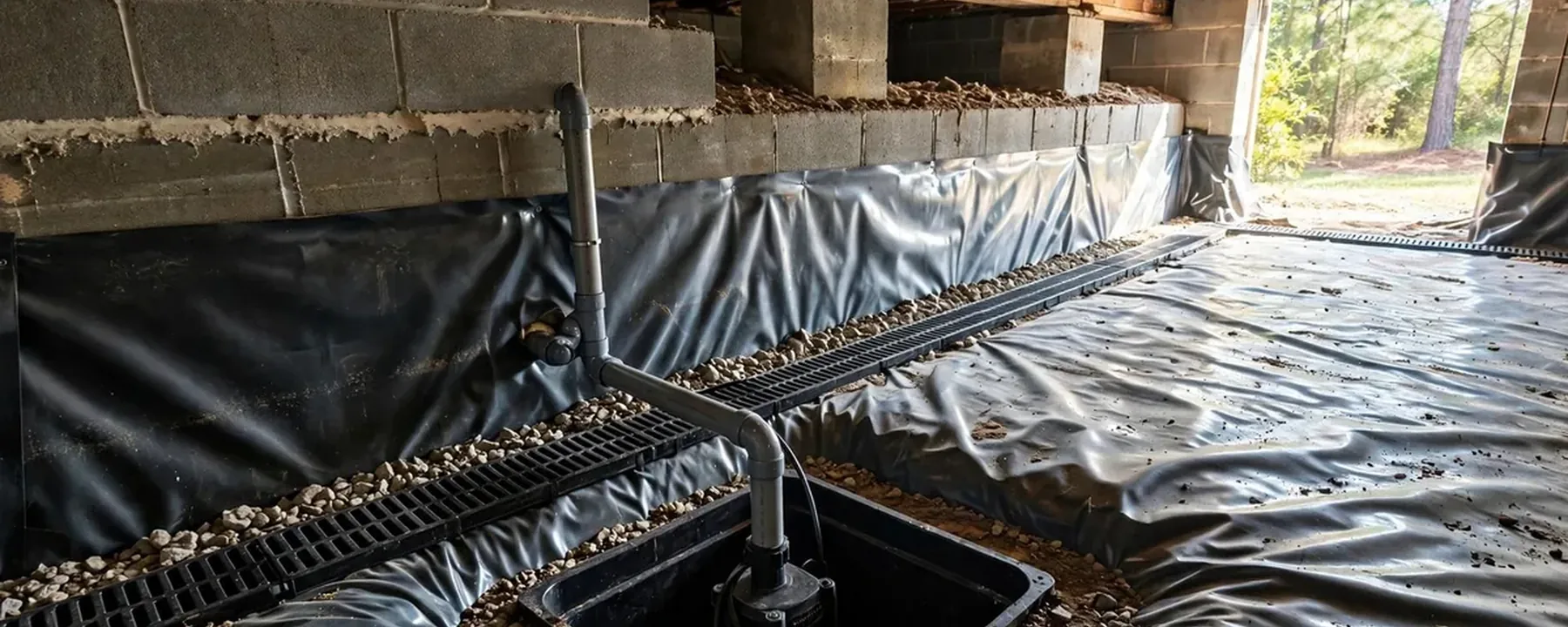
Basement waterproofing in Abington covers two different trades. A plumber handles water that can be collected and piped away, which means interior drains, the sump pit and pump, the discharge line, backwater valves and advice on routing downspouts. A waterproofing specialist handles the structure, which means exterior excavation, wall membranes and foundation crack repair.
Large specialist companies dominate local search for this topic, and for structural work they are often the right call. We would rather say that plainly than sell you the wrong fix. Our line is open 24/7 and a dispatcher can tell you which side of the line your problem falls on, with same-day appointments when available.
What a plumber does and what a waterproofing specialist does
The split follows one question. Is the water being managed after it enters, or is it being stopped at the wall?
Plumber's scope
- Sump pit, pump and battery backup
- Discharge piping to a legal outlet
- Interior drain channels that lead to the pit
- Backwater valves on basement drains
- Guidance on routing downspouts away from the house
- Finding supply and drain leaks that mimic seepage
Specialist's scope
- Exterior excavation and wall membranes
- Structural crack repair and wall bracing
- Regrading the yard around the foundation
- Footing drains dug along the outside of the house
- Foundation repair after movement
- Window well replacement or re-cutting
Where your water comes from and who fixes it
Most wet basements have one dominant source. Matching the source to the fix keeps you from paying for work that does not touch your problem.
| Water source | Typical sign | Usual fix | Who handles it |
|---|---|---|---|
| Groundwater under the slab | The pit fills or the floor edge turns damp after a long rain | Sump pump, pit and interior drain, see sump pump repair | Plumber |
| Roof runoff | Wet wall or corner under a downspout | Extensions, rerouted downspouts, a legal discharge point | Plumber for piping, gutter or landscape crew for the rest |
| Sewer or floor drain backup | Dirty water at the floor drain in storms | Backwater valve or sewer line repair | Plumber |
| A leaking supply or drain pipe | Water appears with no rain and the meter moves | Leak detection and a pipe repair | Plumber |
| Seepage through a wall or crack | Wet streaks on the wall, white mineral crust | Exterior membrane or crack repair | Waterproofing specialist |
| Creek overflow | Water enters at many points during a flood | Cannot be piped out, so planning matters | Township and flood-plan guidance |
How to work out where your water is coming from
A short check before any call helps the plumber and saves you from the wrong job.
Note when it shows up
Water only after rain points to groundwater or runoff. Water in dry weather points to a pipe, condensation or a high water table.
Find where it enters
Check the floor edge, the wall center, a window well and the floor drain. Each location points to a different cause.
Read the water meter
Turn off everything, then read the meter and read it again after two hours. Aqua Pennsylvania says if the meter changes, you likely have a leak.
Look outside
Check whether gutters overflow and whether each downspout empties well away from the wall. Soil that slopes toward the house sends water straight at the foundation.
Photograph and keep a log
Take pictures with dates after each storm. A record of when and where helps whoever fixes it, and your insurer.
Not sure whose job your wet basement is?
Call and describe where the water shows up. A dispatcher is on the line around the clock.
Interior drains, backwater valves and window wells
An interior drain is a channel cut along the base of the wall that catches seepage and carries it to the sump pit. It manages water after it has entered, rather than stopping it outside, and it works best in a basement with a sound pump and a clear discharge. The slab is opened along the wall, so the cost depends on how much floor is cut.
A backwater valve, also called a check valve on a drain line, closes when sewage tries to flow backward. The township suggests a check valve on basement drains, which is a practical answer if your floor drain has ever gurgled during a storm.
A French drain buried around the outside of a house is excavation work that most waterproofing companies do. A window well that fills with water may need a drain tied to the pit, or may need to be rebuilt, which is where a plumber and a specialist can both be involved.
Rain, roofs and the rules your discharge must follow
NOAA 1991 to 2020 normals give about 45 inches of precipitation a year at the Philadelphia Northeast Airport station. By simple math, that is roughly 28,000 gallons a year for every 1,000 square feet of roof. Where those downspouts empty decides how much of it your basement meets.
Abington Township asks that downspouts and floor drains stay out of the sanitary sewer, and it says connecting a sump pump there is illegal. Water has to go to the yard, a seepage pit or the storm sewer. Any plan that sends roof water into the sewer, however convenient, should be refused.
Flood history: what plumbing can and cannot do
The township's plan says Abington holds the headwaters of the Tookany, Pennypack and Sandy Run watersheds, and that 76 buildings sit in the one percent annual chance (100-year) floodplain. If your property is near one of those creeks, check the floodplain status with the township before you decide what to buy.
A pump and drain handle seepage and rainfall. They cannot hold back a creek in flood, and the township's own record of the 1996 and 2001 floods shows that limit. After 1996 it bought and demolished 38 homes in the most flood-prone areas, which is the clearest sign that some water is a land problem, not a pipe problem.
Flood damage from a rising creek is usually a separate insurance question from a plumbing failure. Ask your insurer what applies to your address, and ask township staff for your flood map status. The same questions apply on the Jenkintown side of the township line.
What drives the cost of a plumbing-side basement fix
A quote should come with a clear price before work starts, and it should show what is in scope. These are the main drivers.
Water that seeps up from the ground is often excluded unless you carry specific coverage, so read your policy before work. Call (215) 714-6692 to talk through your basement and get a clear price on the plumbing side.
Call for your priceOlder Abington basements and where to start
The median Abington home was built in 1956, per Census estimates for 2020 to 2024, and about 61 percent of the 23,232 homes predate 1960. Many of these basements have older walls and floors, so it is worth treating every damp spot as a clue instead of a project.
Start with the cheapest steps, which are cleaning gutters, extending downspouts and testing your pump. If water still comes in, call and describe it. We handle the plumbing side, and we will say plainly if you need a specialist.
Basement waterproofing questions from Abington homeowners
A plumber does the piping side, which means the sump pit, pump, interior drains, discharge and backwater valves. Exterior excavation, wall membranes and structural crack repair belong to waterproofing specialists.
A sump pump removes water that collects in a pit under the floor. Waterproofing is a wider term and can mean stopping water at the wall. Many dry basements use both together.
A pump alone works if water gathers at one point. A drain along the wall helps when water enters at the floor edge in many places, because it leads the water to the pit.
It is a check valve that closes when sewage flows backward. Abington Township suggests a check valve on basement drains, and it is worth asking about if your floor drain has backed up in storms.
No. The township says downspouts, floor drains and sump pumps must stay out of the sanitary sewer. Water should go to the yard, a seepage pit or the storm sewer.
A French drain is exterior excavation, which most waterproofing companies do. A window well that floods may need a drain tied to the sump pit or a rebuild. Call and describe it, and we will say which part fits us.
Tape a small square of foil to the wall and check it the next day. Moisture on the room side points to condensation, and moisture under the foil points to seepage. A moving water meter points to a pipe.