
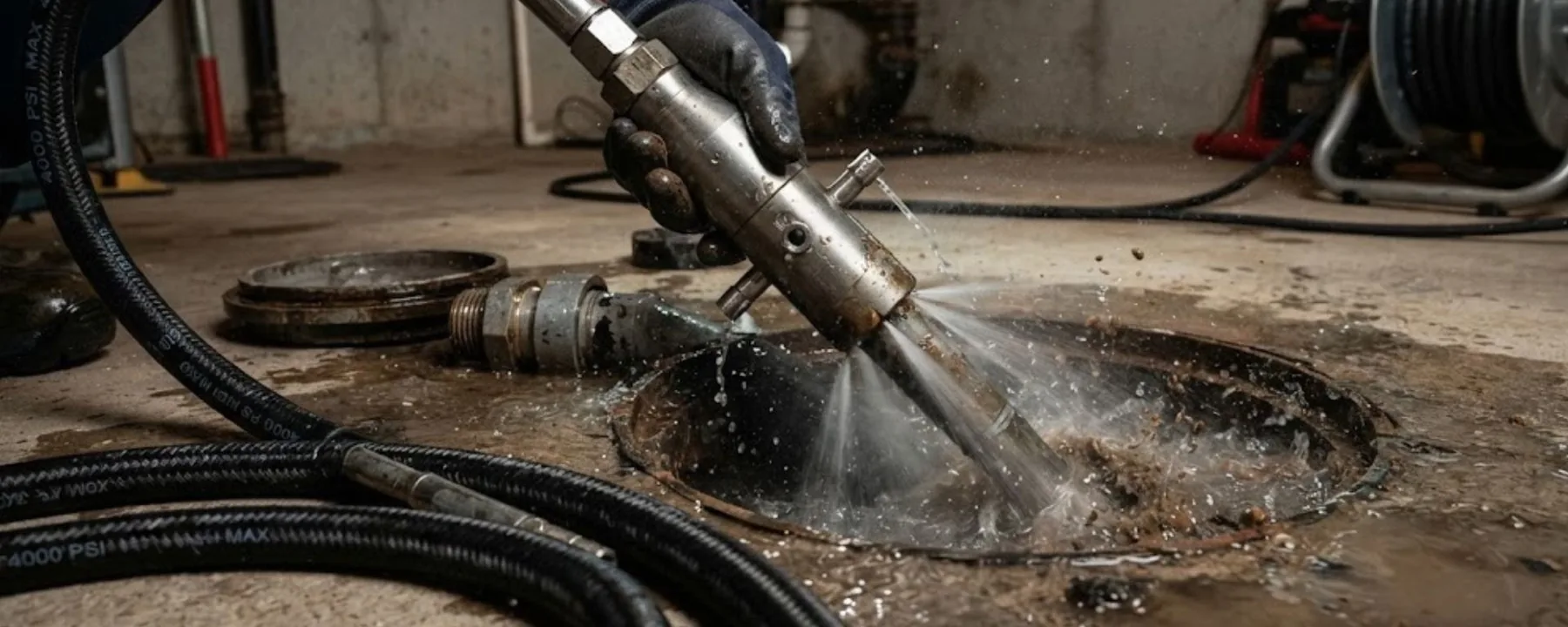
Hydro jetting is a drain cleaning method that sends high-pressure water through a hose and a nozzle to scrub the inside of a pipe. Where a cable pokes a hole through a clog, a jet washes away the grease, scale and silt that made the clog in the first place. It is the usual answer when a drain keeps clogging, and it is a sensible call when sewage is backing up and a cable has not held.
If water is coming up in the house right now, stop using fixtures and call (215) 714-6692. The line is open 24/7, and a dispatcher can tell you whether the situation points to jetting or to a camera look first.
The snake stopped short, or the clog came right back
The cable went in and stopped
A cable that stops partway down a line, sometimes 50 or 60 feet from the cleanout, has met roots, a heavy buildup or a pipe problem. A jet is not the automatic next step, and a camera should come first.
It drains for a few weeks, then slows again
That rhythm usually means the cable opened a narrow channel and the walls stayed coated. The channel narrows again as new grease and soap collect.
Roots show up every spring
Roots follow moisture to a joint and grow into the pipe. Cutting them gives you months, and removing the buildup they catch can give you longer.
The kitchen line never fully clears
Grease that has cooled and hardened on the pipe walls is a job for hot, high-pressure water rather than a cable.
Slow drains in several places
When more than one fixture slows, the buildup is often in the shared branch or the main, where a jet reaches farther than a hand tool.
Different visits, same answer
If two earlier cable visits each fixed it for a short while, ask for a camera and a jetting quote, not a third cable run.
Four things people believe about snaking and jetting
Most of what homeowners hear about jetting is half right. These are the claims we hear most, with what is closer to the truth.
| What people say | What is closer to the truth |
|---|---|
| A snake clears the pipe | A snake clears a path through the pipe. The coating on the walls stays, so the opening can close again. |
| Jetting will blow out old pipes | Pressure and nozzle are matched to the pipe, and a camera look first shows whether the pipe is a fit. Cracked or collapsed pipe is the case where jetting is the wrong tool. |
| If the snake got stuck, jet harder | A stuck cable calls for a look first. It may be roots, an offset joint or a break, and more force does not fix any of those. |
| Roots mean a new sewer line | Roots in a sound pipe are often cut and flushed out, though they regrow. Roots in a broken pipe are a repair question, see sewer line repair. |
What the jet does inside the pipe
The hose goes in through a cleanout or an opened trap. The nozzle has jets that point backward, so the water pulls the hose forward through the pipe, and others that spray the walls in a circle as it passes.
Grease, scale and silt are scrubbed from the pipe and carried toward the main, where the flow takes them away. For roots, the plumber may use a cutting nozzle or a cutter on a cable first, then follow with the jet to wash out what is left.
A second camera pass after the jetting shows the cleaned walls and any damage the buildup was hiding. That record helps you decide whether the pipe needs only maintenance or needs a sewer inspection and repair plan.
What to do first when sewage or gray water comes up in the house
Backups are the urgent side of this service. Whatever tool ends up clearing the line, these steps limit the mess in the meantime.
Stop all water use
No washer, dishwasher, showers or flushing. Water you send down has only one place to go, and it is the opening that is already overflowing.
Keep people and pets out
Sewage on a basement floor is a health concern. Keep children and pets away, and wear boots and gloves if you have to cross it.
Mind the electrics
If water is near a panel, a furnace or a floor outlet, leave the power alone and say so on the phone. Do not wade through standing water to reach a breaker.
Note what is affected
Which drains bubble, which fixtures still work, and whether it started during rain. Those details help us tell a house-line clog from a main line problem.
Call the right line
Call (215) 714-6692 for a plumber. If neighbors have the same problem, also call Abington Township's sewer backup number, 215-884-8329, since the public main may be the cause. Same-day appointments are offered when available.
Sewage coming up in the basement?
Stop using water and call. A dispatcher answers at any hour, day or night.
When jetting fits and when a camera comes first
Jetting is not the answer to every clog. The deciding factor is the condition of the pipe, which is why the camera runs before the water does.
Jetting usually fits
- Grease and soap coating the walls of a sound pipe
- Scale and silt that a cable only partly removes
- Roots in a joint, once a camera shows the pipe is intact
- A clog that has returned after cable cleanings
- Routine maintenance of a line with a known buildup problem
Camera first, jetting may be wrong
- A cable that stopped and would not go farther
- Pipe that looks cracked, belly-shaped or offset
- A line that has collapsed or is partly missing
- Old pipe with joints that have already separated
- A backup that began right after digging or heavy loads nearby
From cleanout to final camera pass: how the visit runs
Find the way in
The plumber locates a cleanout or opens a trap or vent so the hose can reach the line.
Look before spraying
A sewer camera runs through the pipe so the plumber can see roots, buildup and any damage that would rule jetting out.
Jet the line
The nozzle goes in and works back toward the cleanout, scouring walls and flushing debris down the line.
Look again
A second camera pass confirms the walls are clean and shows anything the buildup had covered.
Talk through the result
You get a plain description of what was found, a photo or video where available and a recommendation on whether to schedule maintenance cleanings or repair work.
What moves the price of a jetting visit
Jetting uses heavier equipment than a hand cable, so the price depends on the job and not just the service name. You get a clear price before work starts.
Water-backup damage is often covered only by a specific add-on to a homeowner policy, so check yours early. Call (215) 714-6692 and ask about same-day or after-hours availability.
Call for your priceWhy older Abington lines suit a camera look
About 61 percent of the 23,232 homes in Abington Township predate 1960, with a median build year of 1956, according to Census American Community Survey estimates for 2020 to 2024. Drain and sewer pipes from that era are often cast iron or clay, which can scale up inside or shift at the joints. Houses near Willow Grove and Elkins Park fall in the same age range, so a camera check before jetting is a sensible habit.
The Township also asks residents to keep fats, oil and grease out of the system, and the Township's own name for the problem is FROG, for fats, roots, oil and grease.
Where jetting sits next to the other drain services
For a slow single fixture, drain cleaning with a hand tool or small cable is usually the quicker, cheaper path. For the large pipe that leaves the house, see sewer line cleaning, where jetting is often part of the plan.
Jetting cleans a pipe and does not repair one. If the camera shows a crack, a break or a bellied section, the next step is a repair plan, and we will explain the options before any work begins.
Hydro jetting questions from Abington homeowners
Yes. The dispatch line is open 24 hours a day, every day, including holidays. When sewage or gray water is backing up overnight, call and describe it. We will tell you what to stop using and whether jetting or a camera look comes first.
Snaking runs a spinning cable through the clog and opens a channel. Hydro jetting sends high-pressure water through a hose to scrub the pipe walls clean. A cable removes the blockage and a jet removes what built up around it.
A cable usually stops because of roots, a heavy buildup, an offset joint or a break in the pipe. The reason matters, because jetting a broken pipe can make things worse. A camera look shows what stopped it.
It can if the pipe is already cracked or collapsed. That is why a camera runs first and the plumber matches pressure and nozzle to the pipe. Sound cast iron, clay and plastic are generally good candidates.
It can cut and flush roots out of a sound pipe, usually after a cutting nozzle or cable. Roots tend to regrow where moisture escapes at a joint, so some lines need periodic cleaning or a repair at the joint.
It depends on the pipe, the household and what the camera finds. A line with a history of grease or roots may need cleaning on a schedule, while a clean line may not need it for a long time. Ask the plumber after the camera pass.
Abington Township owns the public sewer main and takes backup calls at 215-884-8329. The Township's guidance says a blockage between the house and the main is a plumber's job. If neighbors are backed up too, call both.
Consumer jetters exist, but they are risky in old or damaged pipe, can spray water back at the person running them and give no view inside the pipe. A licensed plumber with a camera is the safer choice for a main line.