
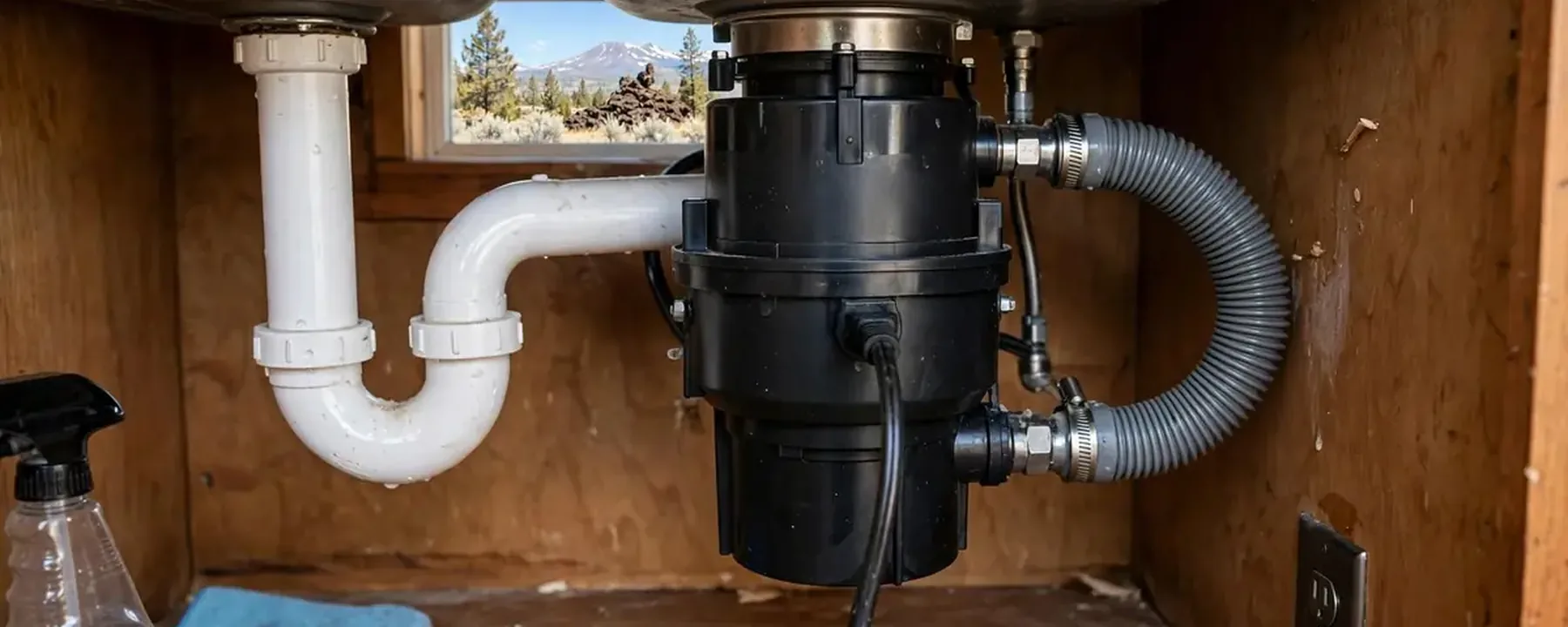
A leaking or jammed disposal is an emergency when water is running into the cabinet or the sink will not drain, and our 24/7 line is open for it now. Switch the disposal off at the wall, never put a hand or tool down the drain, and close the stop valves under the sink if water is spilling out. Then call (215) 714-6692 and tell the dispatcher what you see.
Myths and facts about a failing disposal
Most disposal calls start with a wrong guess about what is broken. This table sets the common ones straight.
| What people assume | What is usually true | What to do |
|---|---|---|
| A humming disposal has a dead motor | The motor has power but the flywheel is stuck on something hard, like a bone, a fruit pit or a bottle cap | Switch it off, then free the flywheel with the hex key socket underneath |
| Water at the back means a cracked unit | It is usually the drain elbow, the dishwasher hose clamp or the sink flange, not the housing | Dry it, run water, and see where the first drops form |
| A leak from the bottom or side can be sealed | The housing or an internal seal has failed, and no tape or sealant lasts | Replace the unit |
| Ice and lemon peels clean the smell | Odor usually lives in the rubber splash guard and the drain line, not the grinder | Scrub the splash guard, and clear the line if the sink is slow |
| Running cold water makes grease safe to grind | Grease cools and coats the pipe farther down, where it builds up | Wipe pans with a paper towel and put it in the trash |
| A disposal that will not turn on is dead | A tripped overload, a tripped breaker or a loose plug can leave it silent | Press the red reset button on the bottom, then check the breaker |
A hum that does not clear after freeing the flywheel and pressing reset usually means the motor itself is worn.
Disposal leaking into the cabinet right now: what to do first
Cut the power first
Turn the wall switch off, and unplug the unit if it has a cord. If it is hardwired, switch off its breaker as well.
Keep your hands out
The blades are dull, but the flywheel can still crush a finger if it moves. If a spoon or a bottle cap fell in, reach in with tongs only after the power is off.
Close the water if it keeps spilling
If water is running out of a pipe or hose and not just from the sink, close the main shutoff and open the lowest faucet. Tell the dispatcher if you cannot.
Empty the cabinet
Move cleaners and the trash can out, put a bucket under the leak and lay a towel on the cabinet floor. A wet particleboard base swells quickly.
Take a photo of the leak
A picture of where the water first shows helps the dispatcher decide what parts to bring.
Call and stay reachable
Give the address, say whether the sink still drains and leave a number that will pick up.
Disposal leaking or jammed?
Switch it off at the wall, then call. A dispatcher is on the line at any hour.
Jam, leak, smell and silence: four problems and their usual fixes
Jam and hum
With the power off, put a hex key in the socket on the underside and turn it back and forth until the flywheel moves freely. Press the red reset button and test with water running.
Leak at the back or the top
A loose dishwasher hose clamp, a worn drain elbow gasket or a bad sink flange seal are common. These are parts and seals, so the unit often stays.
Smell that comes back
Food film builds up on the splash guard, the grinding chamber and the drain arm. Scrubbing the guard helps, and a slow drain is a clue that the line also needs clearing.
No sound at all
Check the wall switch, the plug and the breaker, then press the reset. If it stays silent, the cord or switch may have failed, and the plumber will test them.
What to avoid with a disposal that has stopped
A few habits turn a minor jam into a replacement. Skip these until the plumber has looked.
- Never reach in Not with a hand, a spoon or a wrench. Free the flywheel from below with the hex key.
- Do not pour in drain cleaner Chemical cleaners can sit in the unit, damage seals and splash back onto the next person who works on it.
- Do not keep running it A humming motor that cannot turn will overheat, and repeated resets burn out the winding.
- Skip fibrous and starchy scraps Celery strings, potato peels, rice and pasta swell and tangle in the line.
- Wipe pans before washing Abington Township's wastewater guidance asks residents to wipe oil-coated cookware with a paper towel, put it in the trash and use the disposal less.
Reattaching the dishwasher line
The dishwasher drain hose connects to a small port on the side of the disposal. If that hose has slipped off, the clamp is loose or the port is cracked, water from the dishwasher will leak at the back of the unit. A new clamp or hose is a quick fix, but a cracked port on the housing means the disposal has to be replaced.
After a new disposal is installed, there is one more step. A knock-out plug in the dishwasher port has to be removed before the hose is attached, or the dishwasher will back up into the sink. The plumber takes it out and fishes the plug from the chamber so it cannot jam the grinder.
Repair it or replace it
A disposal is a small appliance with a limited life, so the question is whether the problem is a part or the whole unit.
Usually worth repairing
- A jam freed with the hex key
- A tripped overload or loose plug
- A loose dishwasher clamp or hose
- A worn drain elbow or sink flange gasket
- A unit that hums and then runs normally
Usually time to replace
- A leak from the bottom or the side of the housing
- A motor that hums and will not free after a reset
- Heavy rust inside or outside the unit
- A cracked dishwasher port or flange
- A unit that has been repaired more than once recently
Installing a new disposal: electrical and plumbing connections
A new unit has to line up with the sink, the drain and the power. The plumber works through these connections in order.
Sink flange and mounting
The old unit comes off its mounting ring and the flange is cleaned and resealed with plumber's putty or a gasket. The new mounting assembly then locks the unit under the sink.
Electrical connection
Most units either plug into a switched outlet under the sink or are wired through a cable clamp into a junction box. A sink with no switched power needs new wiring, and that part is electrician's work.
Dishwasher port
The knock-out plug comes out if a dishwasher is connected, and the drain hose slips on with a new clamp.
Drain elbow and trap
The discharge elbow connects to the trap arm. The plumber checks that the trap and the pipe are sound and sloped to drain, since an old trap can crumble when disturbed.
Test run
With the power on, water runs for a minute and the plumber checks every joint, the dishwasher line and the cabinet floor for drips.
When the disposal is fine and the kitchen drain is the real problem
A disposal that seems to jam, gurgles or sends water up the other sink basin may be working fine. If water backs up in the sink while the dishwasher runs, or the sink drains slowly with the disposal off, the clog is in the pipe past the unit. Replacing a good disposal will not fix that, so the plumber checks the drain first.
A slow kitchen line usually calls for drain cleaning, and grease buildup is a common cause. The Township's FROG guidance (fats, roots, oil and grease) is aimed at exactly this, so scrape plates, wipe pans and treat the disposal as a last step rather than a first one.
What decides the price of a disposal repair or swap
Disposals vary a lot in size, power and mounting. You get a clear price before work starts, and these are the factors that move it.
Sudden leaks that soak a cabinet or floor may be covered by a homeowner policy while gradual damage often is not, so photograph the cabinet and call your insurer early. Want your real number? Call (215) 714-6692.
Call for your priceA kitchen plumber who serves your neighborhood
We serve Abington and nearby towns, including Jenkintown. The same dispatch line covers late-night leaks and weekend jams, and same-day appointments are offered when available. If your kitchen drain, disposal and dishwasher all seem to be failing together, a sewer line cleaning visit may be the fix instead.
Garbage disposal questions from Abington homeowners
Yes. The dispatch line is open 24 hours a day, every day, including holidays. Call, say whether the disposal is leaking, jammed or silent and give your address, and we will tell you what to switch off while a plumber is sent.
The motor has power, but something has jammed the flywheel. Switch the power off, use the hex key in the socket under the unit to turn it back and forth, then press the red reset button. If the hum returns, the motor may be worn.
A leak at the back usually comes from the dishwasher hose connection or the drain elbow, which are cheap parts to replace. A leak from the bottom or the side of the housing means the unit has failed internally and should be replaced.
Jams, tripped overloads, loose clamps and worn gaskets are repairs. A leak through the housing, a motor that will not free after a reset or heavy rust usually means a new unit. The plumber will show you what failed before replacing anything.
It is better not to. Chemical cleaners can damage seals and splash onto skin and eyes when someone later works on the unit. If the sink is slow, call a plumber to clear the line mechanically.
The drain hose slips onto the side port of the disposal and is held with a clamp. On a new disposal, the knock-out plug in that port has to be removed first, or the dishwasher will back up into the sink.
The drain past the disposal is probably clogged, often with grease. The disposal is working but the water has nowhere to go. Call for drain cleaning, and scrape pans into the trash instead of grinding greasy scraps.
Most units plug into a switched outlet under the sink or are wired through a clamp into a junction box. If the sink has no switched power, new wiring is needed, and that part should be done by a licensed electrician.