
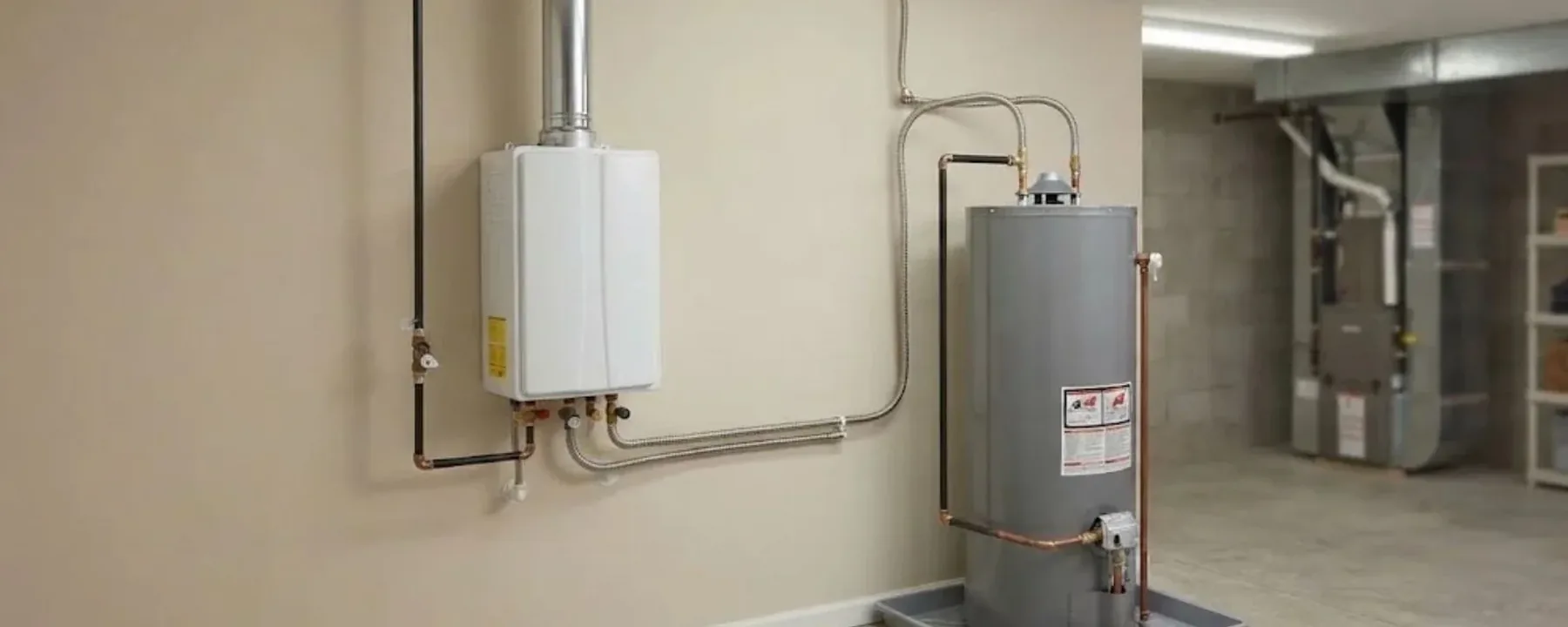
A tankless water heater costs more than a tank replacement because the house usually needs more done around it. The unit itself is only part of the price. Gas line size, venting, a condensate drain, water quality and wall space often decide the rest.
A tankless unit does not save money on day one in most homes. It can pay back over time through lower standby loss and a longer expected life, but both depend on your use and your install. We will not quote a number here, since the real one comes from your basement.
Seven parts of the job that move the total
The gas line
A tankless unit burns a lot of gas when it fires. The line to the unit may need to be larger than the one feeding a tank, and that work adds pipe and labor.
The meter and service
The gas meter and the service to the house must carry the added load. Ask the gas utility before the install, not after.
Venting
These units need vent parts listed for that exact model. Moving the vent through a wall or roof is a cost driver in many houses.
Condensate drain
High-efficiency units make acidic water that must drain away. A nearby floor drain is easy. A drain that is far away adds pipe and sometimes a pump.
Electrical needs
Even gas units need power for the fan and controls. An electric tankless unit needs a heavy circuit, which can mean a panel upgrade.
Water quality
Minerals can scale the heat exchanger. A scale filter or a service plan may be worth pricing in. Test your tap first.
Removing the old tank
Taking out a tank, patching old piping and fitting new valves is part of the labor. A basement corner is easy, a closet is not.
Tank swap or tankless: where the extra work comes from
This comparison shows what tends to be the same and what usually grows.
| Part of the job | 50-gallon tank swap | Tankless install |
|---|---|---|
| Unit and warranty | Lower unit cost, shorter expected life | Higher unit cost, longer expected life |
| Gas piping | Often reuses the existing line | Often needs a larger line and a load check |
| Venting | Existing flue often works with a new connector | New vent parts listed for that model |
| Drain and condensate | Relief valve discharge only | Condensate drain for high-efficiency units |
| Floor space | Needs a footprint on the floor | Mounts on a wall, frees the floor |
| Water treatment | Sediment settles in the tank | Scale can build on the heat exchanger |
These are general patterns. Your plumber can tell you which apply to your house.
Thinking about going tankless?
Call the line, tell us the fuel and the room, and we will say what a visit should check. Same-day appointments when available.
Gas load, PECO and Abington's permit rules
A Department of Energy Building America guide says a gas tankless unit can add 175,000 Btu or more to a home's gas load, and that the in-house gas line serving it will in most cases need to be three-quarters of an inch in diameter.
It also says the incoming gas capacity should be confirmed, and that vent parts should be listed and tested for the particular unit. That is why a gas tankless quote should include a line sizing check before any price is firm.
Abington Township's residential applications page lists a gas line diagram and a PECO adequacy report or form when gas is run to a structure. Plumbing permits in the township are filed by a master plumber registered with the township. Ask your plumber whether your job triggers either form and who handles the paperwork.
We could not confirm any current PECO tankless rebate, so do not count on one. Ask PECO directly whether the existing meter can carry the load and whether any program applies today. If you ever smell gas, leave the building and call the gas utility or 911 from outside before you call a plumber.
Source type: U.S. Department of Energy Building America tankless guide, Abington Township residential applications page and township plumbing permit guidance
What to confirm before you sign a tankless quote
Bring this list to the first visit. Each item is a cost driver the quote should name.
- Gas line sizing The plumber should size the line from the unit's rated input, not guess from the old tank's pipe.
- Utility capacity Ask PECO whether the meter and service can carry the added load.
- Vent route Get the exact vent parts, the route and where the exhaust terminates outside.
- Condensate path Ask where the acidic drain water goes and whether a pump is needed.
- Water test Test your tap for hardness before you decide on a filter or softener.
- Permit and forms Ask who files the permit and the gas forms, and who schedules the inspection.
- Service plan Ask how often the unit should be flushed and what that visit involves.
Hot water that runs out on a cold morning
A tankless unit gives hot water as long as it can heat the flow, but it can struggle when several fixtures run at once. The plumber should ask how many showers and appliances run together. If two bathrooms and a dishwasher overlap in your house, say so before the unit is sized.
Why older Abington houses add a step
Census estimates for 2020 to 2024 put the median Abington home at 1956, with about 61 percent of its 23,232 homes built before 1960. Houses that old often have smaller, older gas piping and a flue built for a tank. Both are good reasons to ask for a gas load check and a venting plan on day one.
The same advice applies in Wyncote and Glenside, where many homes are of a similar age. Our tankless water heater page covers flushing and service, and the water heater installation page covers the planned install side. If you are also weighing a water filter or softener, the plumbing installation page covers that work.
Tankless water heater cost questions from Abington homeowners
It can be, if your gas line, venting and drain are ready for it and you plan to stay for years. It rarely pays back fast. The savings come from low standby loss and a longer expected life, so ask for a full scope first.
The unit costs more, and the house usually needs a larger gas line, new venting and a condensate drain. A tank swap often reuses what is there, so the extra work on a tankless job shows up as extra line items.
Often. A Department of Energy guide says the in-house line serving a gas tankless unit will in most cases need to be three-quarters of an inch. Your plumber should size it from the unit's input and the pipe run.
It can, because minerals can scale the heat exchanger over time. We have no verified hardness figure for Abington water, so test your tap or ask Aqua. A flush plan or a scale filter may be worth pricing.
We could not confirm a current rebate, so do not plan around one. Ask PECO directly whether any program applies to your account and your equipment before you buy, and keep the paperwork if one does.
Plumbing permit applications in the township must come from a master plumber registered with the township. The township also lists a gas line diagram and a PECO adequacy form when gas is run to a structure.
Gas piping, venting and permits make this a job for a licensed plumber. A mistake can mean carbon monoxide or a gas leak. If you smell gas, leave the house and call the gas utility or 911 first.