
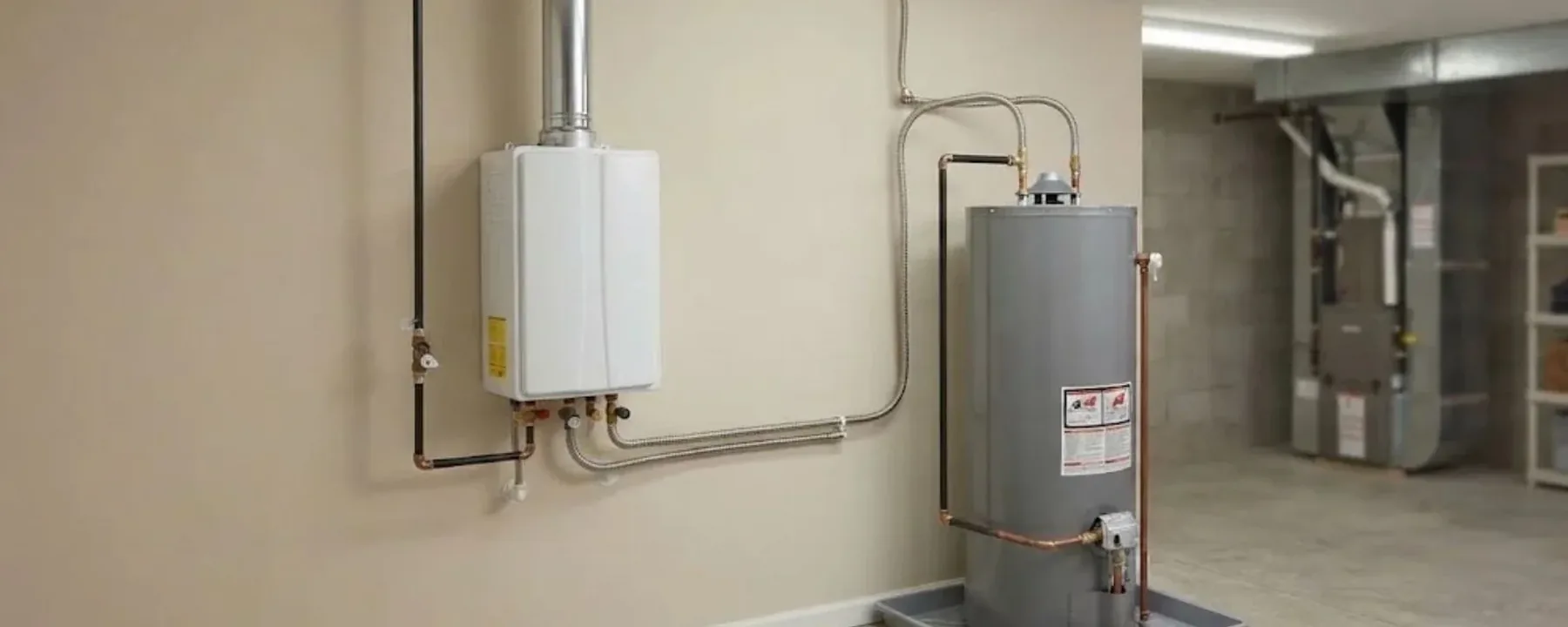
A tankless water heater heats water as it flows through the unit instead of storing it in a tank. When something drifts out of range, it usually shows up as a message on the display, a shower that stays lukewarm, or a burst of cold water between two hot ones.
Those signs are the unit asking for attention. In many cases the fix is a flush, a cleaned filter or an adjusted setting, and the sooner it is done, the less wear builds up inside the heat exchanger.
What the display and the shower are telling you
An error code you do not recognize
Codes differ by brand, so the label inside the cover or the manual names the fault. Scale, a clogged inlet filter, low flow and exhaust problems are common causes, and we can often sort them by phone before a visit.
Lukewarm water at the tap
The unit may be limited by scale on the heat exchanger, by too many fixtures running at once, or by a setting that is lower than you think.
The cold water sandwich
Hot water, a short cold burst, then hot again usually means the water was turned off briefly and the pipe between the heater and the tap cooled. Flow sensors and scale can make it worse.
A message that says it needs a service
Many units show a reminder when a service interval passes. It is a prompt to flush, not a sign that the unit has failed.
A unit that has never been flushed
A tankless that has run for years without flushing may have heavy scale inside. A first flush on a neglected unit can take longer and sometimes shows a part that is already worn.
Tankless flush and descale: what it is and how often
A flush circulates a descaling solution, often white vinegar or a product the manufacturer approves, through the heat exchanger to dissolve mineral scale. The plumber then rinses the unit with clean water, cleans the inlet filter and checks the flow and temperature. Scale acts like insulation on the heat exchanger, so a unit that is full of it works harder and may throw codes.
How often depends on the water. Many manufacturers call for a flush about once a year, and homes with hard water may need it sooner. We cannot give you a hardness figure for Abington, so the honest advice is to test your tap with a simple kit and to ask Aqua Pennsylvania for its annual water quality report for your service area.
Your own manual sets the real interval, and skipping it can affect the warranty. If you cannot remember the last flush, treat it as overdue and schedule one by calling (215) 714-6692.
Unit overdue for a flush?
Call the 24/7 line with the brand, the code and the last time it was serviced. Same-day appointments are offered when available.
Flushing it yourself versus calling a plumber
Units with service valves on the hot and cold lines can be flushed by a careful homeowner. The risk is in the gas side and the parts behind the cover.
A handy homeowner can do
- Read the manual for the flush steps and interval
- Clean the inlet water filter
- Run the descaling solution through the service valves
- Rinse until the water runs clear
- Note any error codes before and after
Leave to a licensed plumber
- Adding service valves to a unit that has none
- Anything involving the gas valve or burner
- Checking the vent for blockage or leaks
- Diagnosing a code that returns after a flush
- Replacing a flow sensor, fan or heat exchanger
Gas versus electric tankless: what each asks of the house
The two fuels behave differently once you look at what the building has to supply. A unit that is easy to run in one house can be impractical in another.
| Item | Gas tankless | Electric tankless |
|---|---|---|
| Fuel or power | Natural gas line with enough capacity for a larger burner | Heavy electrical service, often several large breakers |
| Venting | Needs a sealed vent to the outside, often through a wall | No flue or combustion exhaust |
| Condensate | High-efficiency models need a drain for acidic condensate | None |
| Water flow | Usually keeps up with several fixtures at a time | Can struggle if many fixtures run together in cold months |
| Upgrade risk | Gas pipe may need to be larger, and the vent is new work | The panel may need more room, or a service upgrade |
Models differ, so the plumber confirms exact needs from the unit's nameplate. If you are weighing it against a standard tank, see water heater installation for how the options compare.
When replacing a tank means upgrading the gas line or the panel
The most common surprise in a tank-to-tankless swap is not the heater. A tankless gas unit often burns much more fuel at once than a tank does, so the existing pipe may be too small to feed it. An electric unit can draw more current than a house panel has room for, and that can mean a new circuit or a larger service.
Older Abington houses make this more likely. The median home in the township was built in 1956, and about 61 percent predate 1960, according to Census American Community Survey estimates for 2020 to 2024. That means original gas piping and smaller electrical panels are common enough that checking both before you buy a unit saves a return trip.
If gas work is involved, safety comes first. A gas smell means leave the building, leave the door open and call your gas utility or 911 from outside before calling anyone else. A licensed plumber sizes, installs and tests new gas piping, and a gas leak is not a place for trial and error.
Venting and getting the exhaust out of the house
Gas tankless units vent through sealed pipe, usually out a side wall, and the run has length and elbow limits set by the manufacturer. Condensing models make acidic water that needs a drain or a neutralizer. A basement that vents through an old masonry chimney often needs a new path.
Pick the spot early. A unit placed far from the exterior wall means a longer, costlier vent, and one placed far from the fixtures it serves wastes time waiting for hot water to arrive.
Installing a tankless unit: how the job usually runs
Check what the house can supply
The plumber measures the gas pipe, panel capacity and the route to an outside wall, and confirms the unit size matches your fixtures.
Remove the tank or relocate the old connections
The old heater comes out, and water, gas or electric connections are moved to the wall location.
Mount the unit and run vent and drain
The unit goes on the wall, the sealed vent is sleeved through the building, and the condensate or relief drain is piped.
Add service valves and connect lines
Isolation valves go on the hot and cold lines so future flushes are simple. Gas or power connections are made and checked.
Test and set up
The plumber checks for leaks, runs hot water at several fixtures, sets the temperature and shows you the display and service valves.
Tankless repair: common faults and their usual fixes
Not every fault means replacing the unit. These are common paths.
| What is happening | Likely cause | Usual fix |
|---|---|---|
| Error code on the display | Scale, a dirty filter, low flow or a vent problem | Flush, clean the filter, then check the vent and sensors |
| Water never gets hot enough | Scale buildup, a failing sensor or a low setting | Descale, reset the temperature and test the sensors |
| Unit shuts down mid-shower | Vent blockage, low gas pressure or a safety trip | Inspect the vent and gas supply before restarting |
| Leak at the unit | A worn fitting, or a cracked heat exchanger | Shut off the water, then call for a diagnosis |
| Water heats then turns cold | Flow too low for the sensor, or an uneven demand | Clean the filter and aerators, then recheck flow |
A leak is not an urgent shutdown unless water is spreading, but it is one to book soon. If the unit is old and the heat exchanger has failed, water heater replacement may make more sense than another repair. For a unit that is dripping and you are unsure, see water heater repair.
What decides the price of tankless service and installation
A clear price before work starts is the rule, and these are the items behind it. A flush and a full install are priced very differently.
Warranties for tankless units often depend on documented maintenance, so keep a record of each flush. To get your real number, call (215) 714-6692.
Call for your priceWater quality and your tankless unit
Aqua Pennsylvania publishes an annual water quality report, and it distributes its reports each year by July 1. Ask Aqua for the report that covers your address, and look for anything about minerals. A simple test kit on your own tap tells you what the unit sees every day.
Where tankless service fits with the rest of the house
A new unit often goes in alongside other work, such as a gas line move or a remodel, and that belongs with plumbing installation. If your hot water problem is local to one tap, the fixture may be the cause and not the heater.
We serve homes across Abington Township and nearby towns such as Elkins Park and Wyncote.
Tankless water heater questions from Abington homeowners
Mineral scale builds up inside the heat exchanger, which can cut the hot water output, cause error codes and raise wear on parts. A first flush on a neglected unit may take longer. The plumber can tell you what is worn after the flush.
Many manufacturers call for about once a year, and harder water can mean sooner. We cannot state a hardness figure for Abington, so test your tap and ask Aqua for its annual water quality report. Your manual sets the interval.
Codes differ by brand and model. The label inside the cover or the manual lists them. Scale, a dirty inlet filter, low flow and venting problems are common causes. Call with the code and the brand and we can often narrow it down.
This is the cold water sandwich. Hot water in the pipe is used up, a short cold gap follows while the unit restarts, and hot water returns. A flush, a cleaned filter and a check of the flow rate often help, though some brands show it more than others.
Often yes. A tankless gas unit burns more fuel at once than a tank, so the existing pipe may be too small. The plumber measures the pipe and sizes it for the new unit. If you smell gas at any point, leave the building and call your gas utility or 911.
Sometimes. An electric unit draws a lot of current, so the panel needs room and may need a new circuit or a larger service. The plumber and an electrician check capacity first. It is a bigger project than a like-for-like tank swap.
We do not state a rule here. Ask Abington Township's Community Development office, which administers the plumbing ordinance. Plumbing permit applications come from a master plumber registered with the township.
It can be, but older houses often need gas, venting or electrical upgrades first. If your pipes, panel and venting are in good shape, it works well. The plumber checks all three before recommending a unit.