
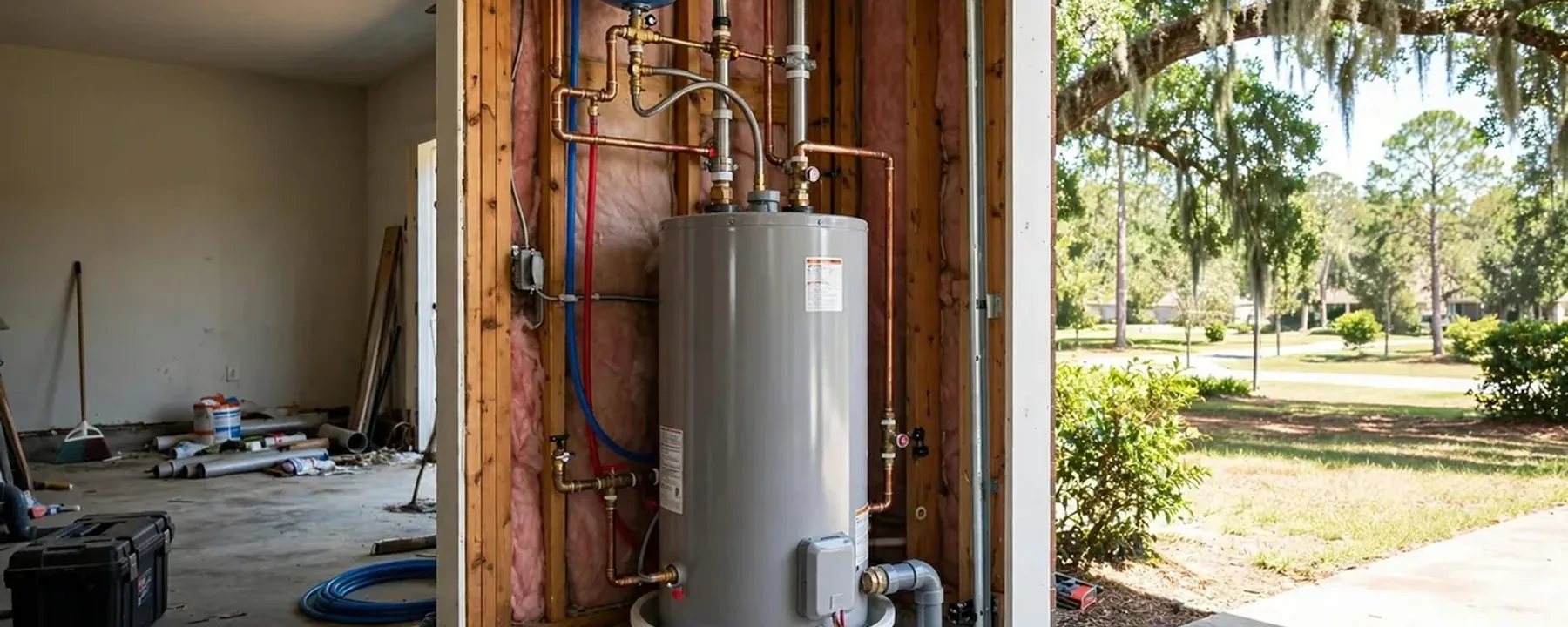
A gas water heater install has six parts: shut off and drain the old tank, set the new one, connect the water lines, connect the gas line and the vent, light it and test it, then walk the owner through the settings. A licensed plumber should do the gas and vent work, because mistakes there can cause gas leaks or carbon monoxide. Many like-for-like swaps finish in one visit, though the time depends on the house.
If you smell gas at any point, do not wait for a plumber. Leave the building, then call the gas utility or 911 from outside. Planning a swap ahead of time? Our water heater installation page covers what a plumber checks on site, and (215) 714-6692 reaches the dispatch line at any hour.
Gas smell? Leave first, call second
Natural gas usually has a rotten-egg odor added so leaks are easier to notice. If you smell it near the water heater, do not flip a light switch or hunt for the leak. Walk out, take everyone with you, and use a cell phone or a neighbor's phone once you are outside.
Call the gas utility's emergency line or 911 before you call a plumber. The township lists PECO as the gas provider in Abington, so find the emergency number on your PECO bill or on peco.com today and save it in your phone. Call (215) 714-6692 after the gas company has cleared the house, so a plumber can repair or replace whatever failed.
What happens during a gas water heater install
Every plumber has a slightly different routine, but this order is typical for a like-for-like swap in an older Abington basement.
Agree on the scope
The plumber checks the old tank's size, the vent route and the gas connection, then explains what stays and what changes. Ask for the scope in writing so a new vent or gas fitting is not a surprise later.
Shut off the gas and water
The gas valve at the heater is closed, the cold supply is shut, and the tank is drained through the bottom valve to a floor drain or a hose run outside. An old tank often sends out a lot of sediment, so draining takes patience.
Disconnect and remove the old tank
The gas connector, vent, water lines and relief valve pipe come off. Even a drained tank is heavy and awkward on basement stairs, which is why a hand truck and two people are common.
Set the new tank and connect the water
The new heater sits level, often in a drain pan. New connectors go on the hot and cold lines, along with a shutoff valve and a temperature and pressure relief valve piped down toward the floor. An expansion tank may be added, depending on the plumbing setup.
Connect the gas line and the vent
A new gas connector and shutoff go on, and every joint is checked with leak-detecting solution, never a flame. The vent pipe is sized to the heater's manual, rises steadily and has tight joints.
Fill, light and test
The tank fills with a hot tap open to push the air out, then the pilot or igniter is lit. The plumber watches the burner flame, confirms the exhaust is drawing outdoors, and checks every gas joint a second time.
Inspection and walk-through
If the job goes through the township, the registered master plumber schedules the inspection. You should leave with the temperature setting, the location of the shutoffs and the manual in your hand.
Planning a gas water heater install?
Call the dispatch line to talk through the vent, the gas connection and a clear price before any work starts.
Vent types and what each one asks of your house
The vent decides more of the job than the tank does. A change in vent type is the most common reason a quote grows, since a new vent adds both parts and labor.
| Vent setup | How exhaust leaves | What to know |
|---|---|---|
| Atmospheric (natural draft) | Rises through a metal vent pipe into a chimney or flue | Common in older homes. Needs a sound flue and a steady upward run. A cracked or oversized chimney often needs a liner. |
| Power vent | A fan pushes exhaust through plastic pipe out a side wall or roof | Needs an electrical outlet nearby and a clear spot outside. The fan is one more part that can wear out. |
| Direct vent | A sealed system with one pipe for exhaust and one for outside air | Does not use room air, which suits a tight utility closet. Needs two pipe runs to the outdoors. |
| Condensing | Cool exhaust leaves through plastic pipe and a condensate drain is needed | Higher efficiency and higher cost up front. Condensing tankless units follow the same rule, see tankless water heaters. |
Follow the vent sizes and clearances in the manufacturer's manual and the code the township enforces. Your plumber should name which one applies to your unit.
Plumbing permit applications in Abington Township must be submitted by a master plumber registered with the township, and that plumber also schedules the inspections. Whether your particular job needs a permit is a question for Community Development. Ask your plumber to confirm the township registration before you sign, and ask that the inspection happen before any work is covered.
Whether a straight swap of one gas water heater for another needs a permit is not something we will state for you. Ask the township's Community Development office at 267-536-1000, ext. 4, open Monday to Friday from 7:30 am to 5 pm. The township's forms list a gas line diagram and a PECO adequacy form when gas is run to a structure, which matters if you are adding a line rather than reconnecting one.
About 61 percent of Abington's 23,232 homes were built before 1960, and the median home dates to 1956, according to Census estimates for 2020 to 2024. Houses that old often have masonry chimneys, and a chimney built for an older boiler may be too big for one water heater. Ask the plumber to look at the flue liner before you pick a model, since a liner can add cost.
PECO also advises keeping gas exhaust vents clear of snow and ice, so check any side-wall vent after a storm.
Source type: Abington Township Code Enforcement and plumbing permit pages, PECO safety guidance, and Census American Community Survey estimates
What you can handle and what belongs to a licensed plumber
Gas work is not a place to learn on the job. The split below keeps the risky parts with someone trained and insured.
Reasonable to do before the visit
- Clear a path and a work space around the old tank
- Take a photo of the nameplate and of the vent
- Find the cold water shutoff and the gas shutoff
- Look outside for snow, ice, nests or debris at the vent
- Write down your questions about the quote
Leave to a licensed plumber
- Cutting, threading or connecting gas pipe
- Lighting the burner and checking the flame
- Sizing and routing the vent
- Setting the relief valve and its discharge pipe
- Handling the township permit and inspection
Questions worth asking before you approve a quote
A good quote answers these without being pushed. If one answer is vague, ask for it in writing.
- Is the vent staying or changing? Reusing a sound vent keeps the job simple. A new vent adds parts, labor and sometimes a wall or roof opening.
- Are the gas connector and shutoff new? Old flexible connectors and stiff shutoff valves are cheap to replace while the tank is out.
- Is an expansion tank part of the job? Ask whether your plumbing setup calls for one, and why. Do not assume it is required by the township.
- Who handles the township side? The permit and inspection go through a registered master plumber, so ask who that is.
- What happens to the old tank? Most plumbers haul it away. Confirm that before the day of the install.
- What is the price before work starts? You should get a clear price before work starts, and any change in scope should be explained before it is added.
Why one install takes longer than another
A swap in the same spot with the same vent is often a few hours of work, while a move across the basement or a new vent route can stretch into a second visit. The things that slow a job are usually access, a damaged flue, old gas piping that needs replacing, and a tank that will not drain cleanly. A plumber can only give a real estimate after seeing the setup.
If your tank has failed and you are deciding whether to patch it or replace it, the trade-offs are laid out under water heater replacement. If you want gas piping added or moved as part of a bigger project, see plumbing installation. We also dispatch to Jenkintown and Willow Grove, and the same steps apply on either side of the township line.
Gas water heater install questions from Abington homeowners
A like-for-like swap often takes a few hours, but the real time depends on the house. A damaged flue, hard access or old gas piping can add time, and a plumber can give a better estimate after seeing the setup.
We do not recommend it. The gas connection and the vent are the two parts where mistakes can leak gas or send exhaust into the house. Abington Township also posts that plumbing permits come from a registered master plumber, so the township's forms point to a plumber, not the homeowner, for any permit that applies.
We cannot state that for you, because the township does not list a water heater swap on its permit forms page. Call Community Development at 267-536-1000, ext. 4, and ask whether your exact job needs one, then have your plumber follow the answer.
Leave the building right away and take everyone with you. Do not use switches or flames. From outside, call the gas utility's emergency line or 911, and call a plumber only after the gas company says the house is safe.
Sometimes. If the old vent is sound and the new heater is the same type, it can often be reused. A different vent type, a damaged chimney liner or an undersized pipe usually means a new vent, and that adds cost.
It is possible, but the details depend on your space. A heat pump water heater needs room around it, a condensate drain and an electrical circuit, so ask your plumber to check the location and the panel before you decide.
Per the township's posted forms, applications must come from a master plumber registered with the township, and that plumber schedules the inspections. Ask your plumber to confirm their registration and to tell you when the inspection is booked.