
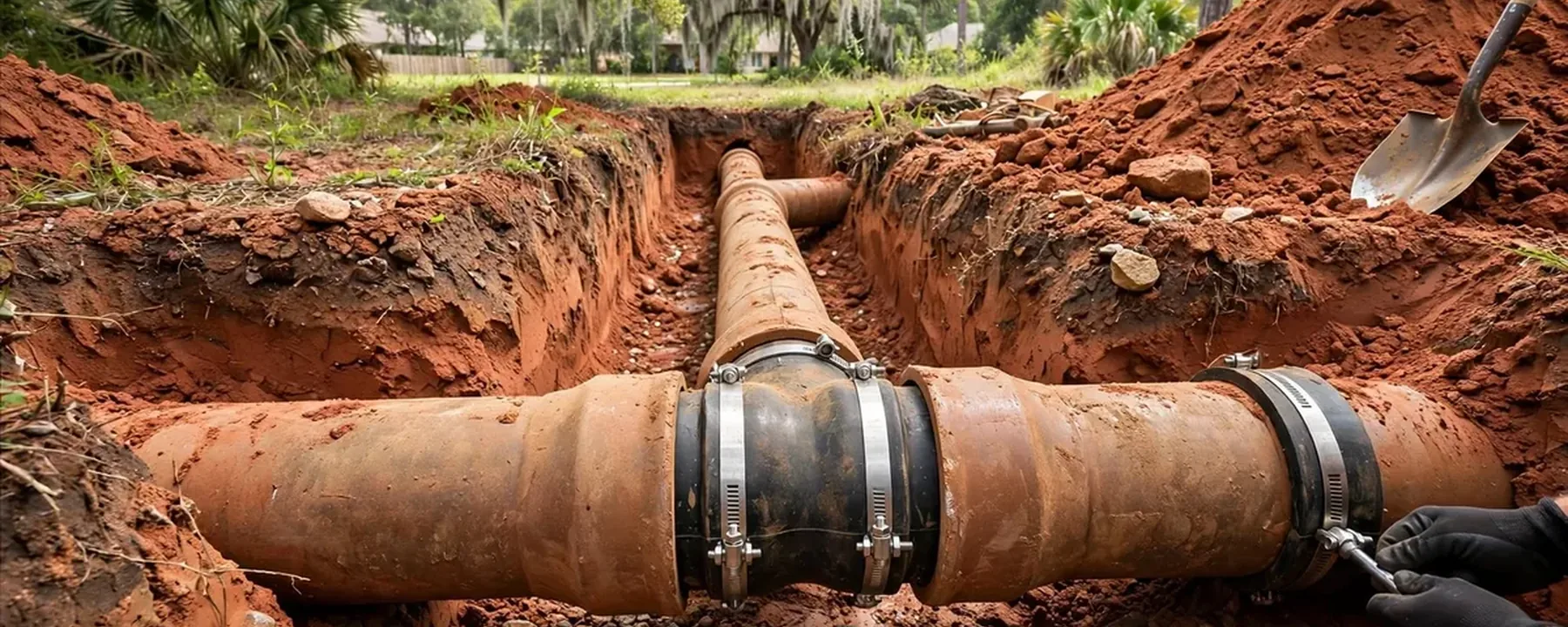
Trenchless sewer line repair fixes a buried sewer pipe through one or two small access holes instead of one long open trench. The two common methods are pipe lining, where a resin-soaked sleeve hardens inside the old pipe, and pipe bursting, where a new pipe is pulled through as the old one is broken apart. Which one fits depends on what a camera finds, so the inspection always comes first.
Trenchless is not always possible. A pipe that has collapsed, sags in a low spot or has a badly broken joint may still need a dug repair at that spot. A good plumber will tell you which case you have before quoting anything.
Why the camera goes down the pipe before anyone picks a method
Nobody can choose between lining and bursting by looking at the lawn. The decision comes from what is inside the pipe, and the work usually runs in this order.
Clear the line enough to see
Roots, grease and scale hide the pipe wall. The plumber may cut or jet the line first so the camera has a clean view. The sewer line cleaning page explains that stage.
Run the camera from end to end
A small camera on a flexible rod travels from a cleanout toward the main. It shows cracks, offset joints, root entry, sags and the pipe material. Ask for the recording, since a clip is the best proof of what is down there.
Mark the depth and the route
A locator tracks the camera head from above ground. That tells the crew how deep the pipe sits and where it bends. It also shows whether the line runs under a driveway, a big tree or the street.
Match the method to the damage
Light cracking and root entry often suit lining. A pipe that has lost its shape may call for bursting or a dug repair. The picture on the screen decides, not a crew's habit.
Get the scope in writing
The proposal should name the method, the length, the access points and what gets restored afterward. Ask what happens if the crew finds something unexpected halfway along.
Lining, pipe bursting and digging side by side
These are general patterns, not promises. Your pipe, soil and layout can change the answer.
| Method | How it works | Usually fits | Main limits |
|---|---|---|---|
| Pipe lining | A resin-soaked sleeve is pulled in, inflated and cured to form a new pipe inside the old one | Cracks, root entry and leaking joints in a pipe that still holds its round shape | Needs an open, fairly straight pipe, and the liner slightly narrows the inside |
| Pipe bursting | A cutting head pulls new pipe along the old path and splits the old pipe outward | Pipe too damaged to line, or a job where a new pipe material is wanted | Needs entry and exit pits, and nearby utilities can limit it |
| Open dig | The crew trenches down to the pipe and replaces the bad section | A collapsed pipe, a deep sag, a broken fitting or one short bad spot | Torn-up yard, driveway or sidewalk, and the longest cleanup |
| Spot patch | A short sleeve covers one defect | One isolated crack or joint in an otherwise sound pipe | Does nothing for the rest of the pipe if it is also wearing out |
Ask your plumber which row your camera footage matches and why.
Want a camera on your sewer line?
Call the line and describe the symptoms. A dispatcher will tell you whether same-day service is available.
What Abington Township says about sewer repairs
The township's wastewater page tells homeowners with a blockage to call a plumber and recommends asking the plumber to televise the pipes. It also warns residents to be cautious of contractors who immediately want to excavate and replace pipes. That is a good reason to demand camera footage before you agree to any digging or any big proposal.
The page does not say where the township's responsibility for a lateral ends, and we found no township statement on who owns the pipe from the house to the main. Ask the township before you assume either way.
The township's code also says building sewers must sit deep enough to be protected from frost, and that a repaired or newly installed building sewer needs a cleanout fitting at the curb. Ask your plumber to price those items, because they can change the scope of a trenchless job.
Plumbing permits in Abington are filed by a master plumber registered with the township, who also schedules the inspections. If the pipe runs under a township street or under Old York Road, which is Route 611, ask Code Enforcement whether the township or PennDOT needs to be involved.
Source type: Abington Township wastewater page, township code of ordinances on sewers, township plumbing permit guidance and PennDOT permit guidance
Signs a trenchless fix will not work on your line
The pipe has collapsed
A liner needs a pipe it can travel through. If the camera cannot get past a crushed section, that spot has to be opened.
A deep sag holds water
A low spot in the grade, sometimes called a belly, keeps waste sitting there. Lining follows the old shape, so the sag stays unless the pipe is replaced.
The pipe is badly offset at a joint
When two pipe ends have shifted apart, a liner can bridge small gaps but not a large step. A big shift usually points to a dug repair.
Several fittings or bends cluster together
Tight bends and many connections make it hard to pull a liner or a new pipe through. The crew may open the worst spot and treat the rest.
Another utility crosses too close
Bursting pushes the old pipe outward, so a gas or water line close by is a concern. The crew needs marked lines first, and the state's 811 call comes before any digging.
What to ask for and what should make you pause
Sewer work is a large decision, and a clear proposal protects you. Use these two lists when you compare quotes.
Ask for these in writing
- The camera recording from start to finish
- The method, the length and the access points
- What gets restored and what does not
- Who files the permit and schedules inspections
- A clear price before work starts
Pause if you hear this
- Digging is the only option, with no footage
- The price is quoted before any camera work
- The permit is your job to figure out
- The scope changes the moment work starts
- No one can say where the pipe actually runs
What drives the cost of a trenchless job
A trenchless job costs more or less depending on a few facts the camera reveals. Length matters, and so does depth, pipe size and how many access pits are needed. A line under a driveway, a deck or a mature tree is harder to reach than one under open lawn.
Restoration also counts. Trenchless work leaves less lawn damage, but pits still need to be filled and the surface repaired. If you want to compare a trenchless quote with a dug quote, ask each plumber to list the restoration line by line. Our sewer line repair page covers the repair side, and the sewer inspection page covers the camera work.
Where this matters around Abington
Many houses in the township are old. Census estimates for 2020 to 2024 put the median home at 1956, and about 61 percent of the 23,232 homes were built before 1960. Sewer laterals from that era were often clay or similar older material, so cracks and root entry are common reasons to look at a camera first.
Neighbors in Jenkintown and Glenside share this housing age, so the same advice applies on both sides of the township line. If more than one drain in your house is slow, or a drain keeps backing up after being cleared, that is the moment to book a camera inspection.
Trenchless sewer repair questions from Abington homeowners
Often, but not always. Trenchless work usually disturbs less lawn and fewer paved areas. A collapsed pipe, a deep sag or a badly offset joint may still need a dug repair, and the camera shows which case you have.
Many jobs fit in a day or two, but it depends on the length, depth and access. Curing a liner also takes time. Your plumber can give a realistic window once the camera work is done and the scope is known.
A liner narrows the inside of the pipe by a small amount, but its smooth wall can still flow well. A pipe that was already crushed or sagging is a poor candidate. Ask your plumber how the liner affects flow in your line.
Plumbing permits in the township are submitted by a master plumber registered with the township. Whether your specific job needs one is a question for Code Enforcement, so ask your plumber to confirm before work starts.
We found no township statement that defines where the owner's pipe ends. The township does say it is responsible for repairs found during its own main and manhole inspections. Ask the township before assuming who pays for what.
You can watch for slow drains, avoid flushing wipes and grease, and ask for camera footage. Cutting, lining and replacing sewer pipe is work for a licensed plumber because it affects the public sewer and needs inspections.
Old York Road is Route 611, and PennDOT requires a permit for work on state highway land. Ask the township and your plumber early, since a route through a road or its shoulder can add steps to the schedule.