
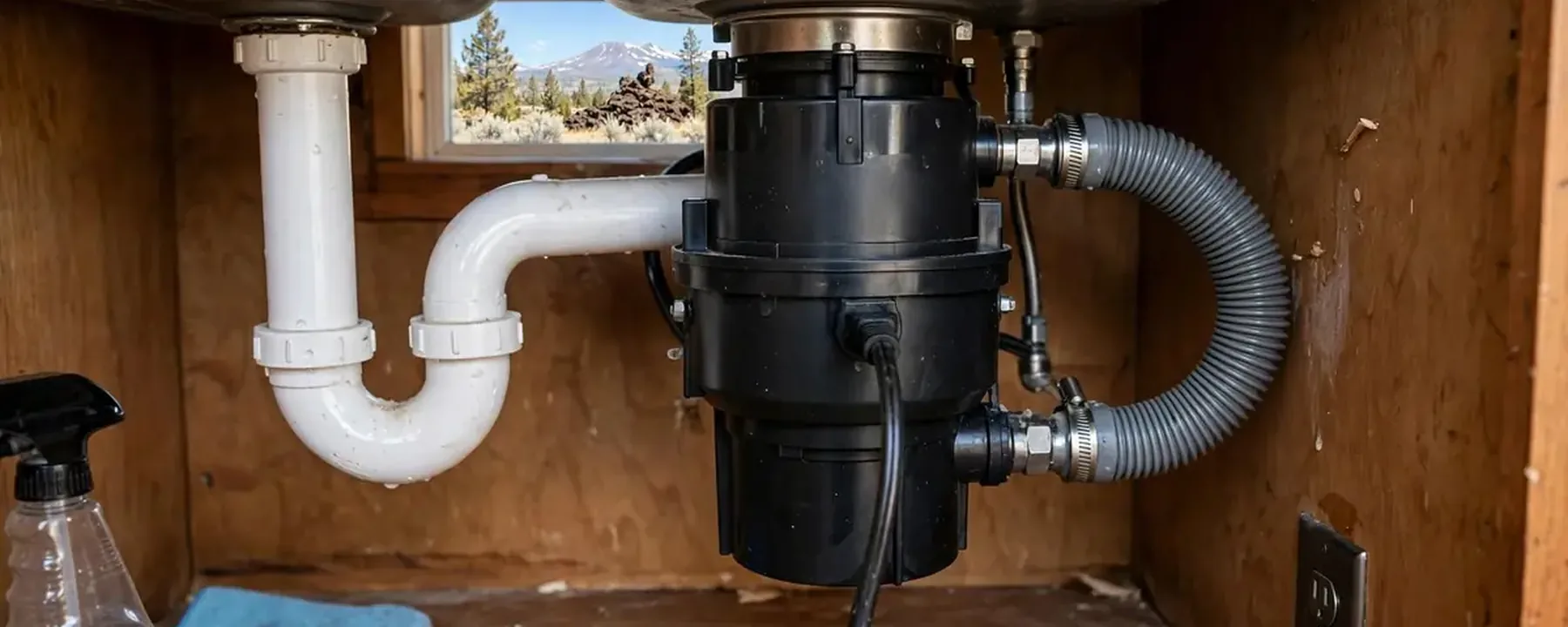
Water leaves the sink through a strainer, passes through the disposal, then drops through a short discharge tube into a P-trap. The trap holds a small plug of water that blocks sewer gas, and a trap arm carries the flow into the wall drain, which is vented to the roof. The dishwasher drain hose joins this path at a port on the disposal or at a tailpiece on the sink side.
A plumber's job is to make every joint tight, keep the trap in place, and set the slope so water keeps moving. The dishwasher line should loop high or pass through an air gap so dirty water cannot flow back, in whatever form your plumber installs it to code.
Follow the water from the strainer to the wall
Every kitchen is a little different, but nearly all of them follow the same path. Open the cabinet under the sink and you can trace it.
Sink flange and strainer
A flange sits in the drain hole and is sealed with putty or a gasket. A mounting assembly underneath locks the disposal to it.
The disposal itself
A motor spins a plate that throws scraps against a grind ring. It does not use sharp blades like a blender, and it needs running water to flush the pieces along.
The dishwasher connection
The dishwasher drain hose attaches to a small inlet on the disposal. New units often have that inlet plugged, so the plug has to be knocked out or the dishwasher will not drain.
Discharge tube and P-trap
A short pipe leaves the disposal and meets the trap. The U-shaped bend keeps a water seal in place that stops sewer gas from rising into the kitchen.
Trap arm and vent
The trap arm runs into the wall at a slight downward pitch. A vent line connects nearby so air can enter behind the water and keep the drain from gurgling.
Where kitchen sink leaks usually start
Water at the top flange
Drips around the rim of the drain opening often mean the seal under the flange has dried out or the mounting ring has loosened.
Water from the side of the disposal
A wet seam on the disposal body usually means a worn internal seal. Most plumbers replace the unit rather than patch it.
A drip at the dishwasher hose
The clamp on the hose may have loosened, or the hose may have cracked. It is a small fix if caught early.
Seepage at the trap nuts
Slip nuts can loosen after a plunger or a clog clearing. Hand-tightening sometimes stops it, but cracked plastic washers need replacing.
Wet cabinet floor near the supply lines
A weeping shutoff valve or braided supply hose can look like a drain leak. Dry each joint with a paper towel and watch which one wets first.
Try it yourself or call a licensed plumber
Cut power to the disposal at the breaker or unplug it before reaching near it, and never put a hand into the chamber.
Reasonable to try at home
- Press the reset button on the bottom of the unit
- Free a jammed plate using the hex socket under the unit if yours has one
- Hand-tighten a loose slip nut and recheck
- Run cold water while grinding and for a short time afterward
- Clear the sink strainer and the dishwasher hose of food debris
Leave to a plumber
- A leak from the disposal body
- Moving a trap, adding a vent or changing the drain slope
- Hardwiring a disposal or replacing its power cord setup
- Sink water backing up into the dishwasher
- A drain that clogs again soon after being cleared
Leak under the sink right now?
Close the shutoff valves under the sink and call. A dispatcher can tell you whether same-day service is available.
What Abington Township says about disposals and kitchen drains
The township code allows ground garbage from domestic garbage grinders of an approved type to enter the sewer, so a disposal itself is not prohibited. The same code bars waste with more than 100 parts per million of fat, oil or grease, and the township wastewater page asks residents to limit disposal use and keep grease out of drains. In practice, a disposal is fine for soft scraps, and grease is where your kitchen line gets in trouble.
The code also says grease interceptors are not required for private living quarters or dwelling units. That means a typical home kitchen does not need one, but it also means your own habits and trap are the only protection against grease buildup. The township owns the sewer main, so a backup into several fixtures when no one is using water is a call to 215-884-8329.
Abington's code lists replacing dishwashers, traps and sinks as residential work that still needs a township permit, and plumbing permits are filed by a master plumber registered with the township. Swapping only a disposal is not on that list in the notes we checked, so ask the township's Code Enforcement office at 267-536-1000, ext. 4, or ask your plumber whether your job needs one.
Source type: Abington Township code of ordinances, Abington Township wastewater page and Code Enforcement permit information
What a plumber does at each stage of a kitchen sink job
Quotes make more sense when you know what each line covers. These are the common tasks and the questions worth asking.
| Job | What the plumber does | Worth asking |
|---|---|---|
| Disposal replacement | Removes the old mounting assembly, seats the new unit, reconnects the discharge tube and the dishwasher inlet | Is the dishwasher knockout plug removed, and does the unit need its own outlet? |
| Dishwasher hookup | Runs the drain hose to the disposal or tailpiece with a high loop or air gap | How will the hose be supported so it does not sag? |
| Trap or leak repair | Replaces worn washers, cracked pipe or a corroded trap and checks the slope | Is the trap arm pitched toward the wall? |
| Recurring sink clog | Clears the line with a cable and often checks the wall drain with a camera | Could a venting problem be causing slow drainage? |
| Sink or layout change | Reroutes supply and drain lines, adds a vent if required, and files the permit | Does the work need a township permit and inspection? |
Ask your master plumber to confirm the dishwasher drain method and trap arrangement meet the code in effect in Pennsylvania.
Where this shows up around Abington
According to Census American Community Survey estimates for 2020 to 2024, about 61 percent of the homes in Abington Township were built before 1960. Many kitchens in those houses have been remodeled at least once, and the drain behind the cabinet may be the original run. A new sink or disposal on an old drain line can expose a trap arm that is too long or poorly pitched.
If your kitchen shows a leak or a jam, a visit for garbage disposal repair is the usual starting point. A worn faucet or supply valve at the same sink is a faucet repair job. A drain that keeps backing up after a cleaning may need a bigger look, which is where drain cleaning with a camera comes in.
Homeowners in Willow Grove and Elkins Park include many older houses where the kitchen drain may be the original run. If you are not sure whether a gurgle is a vent problem or a clog, call (215) 714-6692 and describe what you hear.
What not to send down a disposal
Grease, oil, coffee grounds in bulk, potato peels, pasta and rice are common causes of kitchen clogs. They swell, stick or harden in the trap and the wall drain, even when the disposal grinds them fine. Scrape plates into the trash first and use the disposal for small soft scraps.
Kitchen sink and disposal questions from Abington homeowners
The township code permits ground garbage from domestic garbage grinders of an approved type. It also limits fat, oil and grease in the sewer, and the wastewater page asks residents to limit disposal use. Soft scraps are fine, grease is not.
The drain line is usually partly blocked, the disposal inlet plug was never removed, or the hose lacks a proper high loop or air gap. A plumber can trace which one by checking the hose path and the disposal inlet.
The curved section holds a small amount of water that blocks sewer gas from rising into the kitchen. It also catches heavy objects that fall down the drain. If the water seal dries out or the trap is missing, odors can enter the house.
Gurgling often means air is struggling to enter the drain line behind the water, which points to a vent problem or a partial clog. If it happens at other fixtures too, call a plumber to check the main drain.
Some homeowners do, but the job includes wiring, a mounting assembly and a drain connection that must be tight. Abington's code also lists replacing dishwashers, traps and sinks as work that needs a township permit through a registered master plumber, so ask the township first.
Food film often builds up on the underside of the disposal splash guard and in the trap. Cleaning those parts helps. If the smell persists, a dry trap, a leak or a vent problem may be the cause and a plumber should look.