
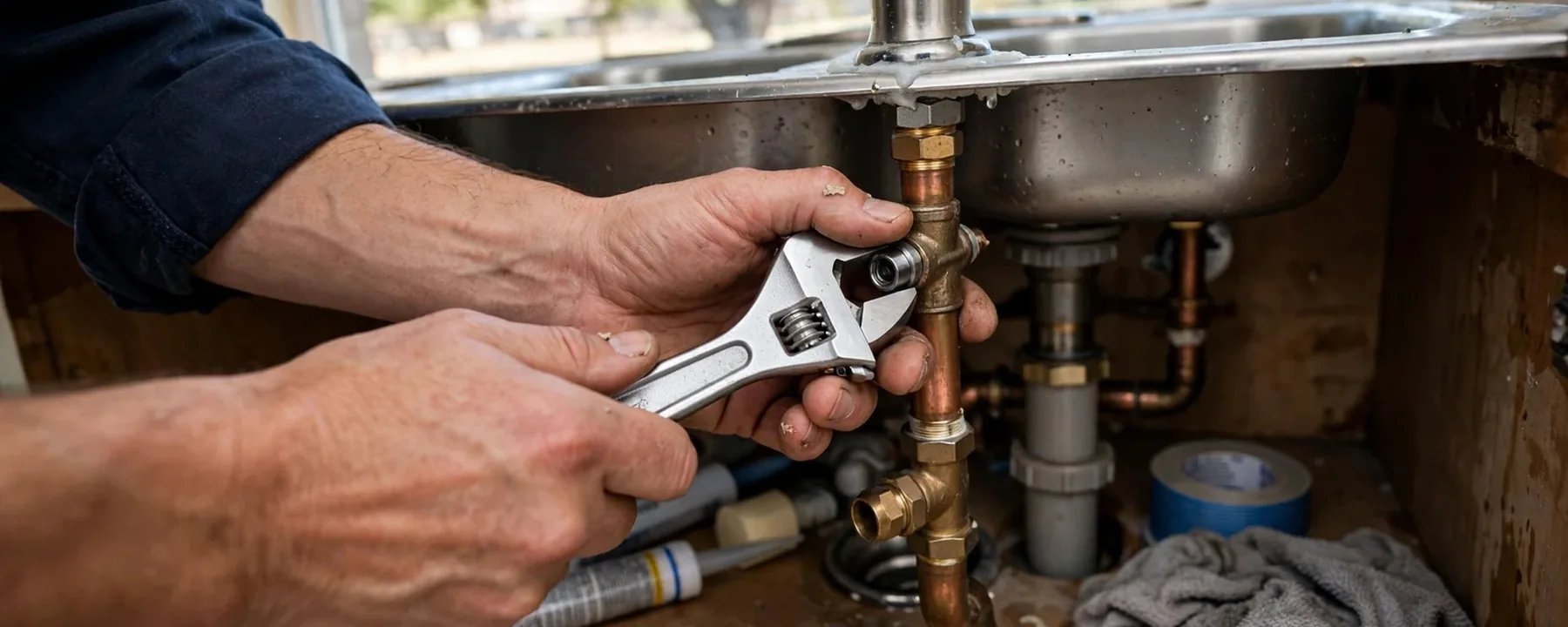
A valve that will not close is an emergency because the water keeps coming until something upstream stops it. Our 24/7 line is open now, and while you dial you can try the oval stop valve under the sink or behind the toilet by turning it clockwise with your hand only.
If the stop spins loose, will not move or weeps at the stem, go straight to the main shutoff, which in many Abington basements sits on the wall nearest the street, close to the meter.
Emergency faucet and valve repair begins with that fallback because old stops seize. The median house in Abington Township was built in 1956, so a stop valve that has not been turned in decades may well be original. Call (215) 714-6692 once you have the water off, or call first and we will stay with you while you try.
Stop valve will not close: the fallback to the main
Work through these in order. Each one is safer than the next.
Try the fixture stop by hand
Turn the small oval handle clockwise. A quarter-turn ball valve stops at a half turn, and a multi-turn valve may need several rotations.
Do not force a seized stem
Pliers and wrenches can snap a stem or crack the valve body, which turns a slow drip into an open pipe. If it fights you, leave it and move on.
Go to the main shutoff
A lever turns a quarter turn across the pipe to close. A round handwheel turns clockwise until it stops. Tell the dispatcher which kind you have.
Drain the lines
Open the lowest faucet in the house, such as a basement sink or outdoor spigot, to pull water out of the pipes and reduce pressure at the leak.
Catch and protect
Put a bucket or towels under the leak, empty the cabinet and keep cords away from the wet floor. Photograph the damage before you clean up.
If the main will not close either
Say so on the phone, because that changes the plan. Aqua owns the meter, so do not operate anything at the meter or curb unless Aqua tells you to. Aqua customer service is 877-987-2782.
Valve stuck and water still running?
Get to the main shutoff, then call. A dispatcher is on the line at any hour.
Four faucet designs and how each one wears out
Cartridge faucets
A single lever moves a sealed cartridge. When the seals wear, you get a drip from the spout or a lever that feels loose. The fix is usually a new cartridge.
Ceramic disc faucets
Two polished discs slide against each other inside the body. They last a long time, but mineral grit can scratch them and cause a slow drip that a new disc set cures.
Compression faucets
Separate hot and cold handles press a rubber washer onto a seat. A worn washer or a pitted seat causes a drip, and the older the faucet the more likely it is.
Ball faucets
A single handle turns a slotted ball against springs and seals. Leaks usually come from worn seats and springs, or from the O-rings at the base of the spout.
A broken or burst supply valve under the sink
The braided line that feeds a faucet can burst at its coupling, and the stop valve can start leaking from its stem or from the compression nut. Water then runs down the cabinet floor and into the wall behind it. You may notice a damp cabinet back, a hissing sound or a sudden drop in pressure at that one sink.
A plumber will usually shut the main, cut out the failed valve and install a new quarter-turn stop with a fresh braided line. If the copper stub coming out of the wall is crumbling or pitted, that stub has to be replaced too, and a patch on weak pipe tends to leak again. When water has already run into a cabinet floor or wall, ask about a leak detection check to be sure it is not still going somewhere.
If more than one fixture is losing water, or the leak is in the wall, treat it like the burst pipe emergency it may be. Keep the main closed until the plumber says otherwise.
Repair the faucet or replace it
A faucet can be rebuilt many times, but it is not always worth it. The plumber compares the body, the parts and the finish before recommending either.
Repair usually makes sense when
- The drip comes from the spout or a handle only
- The body and finish are sound
- A matching cartridge, disc or washer is available
- The faucet is fairly recent and has not been repaired before
- The fixture matches the sink and counter you want to keep
Replace usually makes sense when
- The body is corroded, pitted or cracked
- Parts are discontinued or hard to find
- The same faucet has leaked after earlier repairs
- Water seeps from the base or under the sink
- You want a taller spout, a pull-down spray or a touchless model
Where shower valve and tub faucet leaks start
Shower and tub leaks often hide behind tile, so the symptom is a better clue than the spot. This table shows the common patterns.
| What you notice | What is usually behind it | What the plumber does |
|---|---|---|
| Tub spout drips after you shut off the water | A worn cartridge, stem or diverter in the valve behind the wall | Replace the cartridge or valve trim |
| Water leaks around the shower handle | A worn seal or loose trim plate | Replace the trim and reseal the plate |
| Water barely switches from tub to showerhead | A worn diverter or a clogged valve | Replace the diverter or clean the valve |
| Temperature swings when another fixture runs | A worn pressure-balancing cartridge | Replace the cartridge |
| Stain on the ceiling or wall near the bathroom | A leaking valve body, a joint or the tub drain connection | Open an access panel, find the source and repair it. See leak detection |
A shower valve repair in tiled walls may need an access hole, and the plumber will tell you where before cutting.
Outdoor spigots and the first freeze
A spigot that drips only when a hose is attached usually has a worn washer, a failed packing nut or a bad vacuum breaker. A spigot that leaks inside the wall after a cold night may have split behind the siding, where it is hard to see. NOAA normals for the Philadelphia Northeast Airport station put the average first fall freeze near November 7 and the last spring freeze near April 4.
In practice, that means hoses should come off, the interior shutoff to each spigot should close, and the spigot should drain before early November. Hold off on reconnecting hoses until after early April. The Township's code lists replacing bib valves among residential work that can need a permit, so ask Community Development before swapping one.
Shower and tub drains that will not clear
A tub or shower that drains slowly is usually a hair-and-soap clog in the trap, and a drain snake or a clean-out of the stopper often clears it. Chemical openers can damage old fittings, so use them with caution. If the tub, the toilet and a basement drain all gurgle together, the clog has moved to the main line and drain cleaning is the next step.
What decides the price of a faucet or valve job
Faucet jobs look alike from the outside, but the work behind the wall can be very different. You get a clear price before work starts, and these are the factors that move it.
Sudden, accidental water damage may be covered by a homeowner policy while slow drips usually are not. Photograph the cabinet and floor, and call your insurer early. Want your real number? Call (215) 714-6692.
Call for your priceWhen the leak is at the meter, not the faucet
Aqua Pennsylvania supplies public water to most of Abington Township. Aqua says it owns the meter, while the customer is responsible for a clear meter location and for the plumbing inside an outdoor meter pit.
If a valve at the meter is leaking or stuck, call Aqua's customer service line at 877-987-2782 as well as us, because the repair may sit on either side of that line. We serve Abington and nearby towns, such as Willow Grove, day or night.
Faucet and valve questions from Abington homeowners
Yes. The dispatch line is open 24 hours a day, every day, including holidays. Call, say which valve or fixture is leaking and give your address, and we will tell you how to stop the water while a plumber is sent.
Older valves often seize from mineral buildup and years without use, or the washer inside has failed. Do not force it, because the stem can snap. Close the main water valve instead and call so the valve can be replaced.
A faucet with a sound body and a drip at the spout can usually be rebuilt with a new cartridge, disc or washer. A body that is corroded, cracked or leaking at the base, or one with discontinued parts, is usually better replaced.
Close the stop valve if it still works. If it does not, close the main water valve at the basement wall, open the lowest faucet to relieve pressure and call. Empty the cabinet, take photos and keep cords out of the water.
A spigot that froze and split may leak only when the hose is on or the water is running. Disconnect hoses, shut the interior valve, drain it before early November and call if water shows at the siding or inside the basement.
Sometimes. Many valves can be repaired from the front by removing the trim and replacing the cartridge. If the valve body is cracked or the leak is at a joint behind the tile, an access opening is needed, and the plumber will tell you where first.
Yes, in many cases. Jetted tub problems usually involve the pump, an air control or a seal, and some are accessible through a panel near the tub. Call and describe what you see, and we can tell you whether a plumber is the right visit.
Remove the stopper and pull out the hair, then try a small drain snake. If the tub, toilet and a basement drain are all slow or gurgling, the problem is deeper in the line, and a plumber should clear it.