
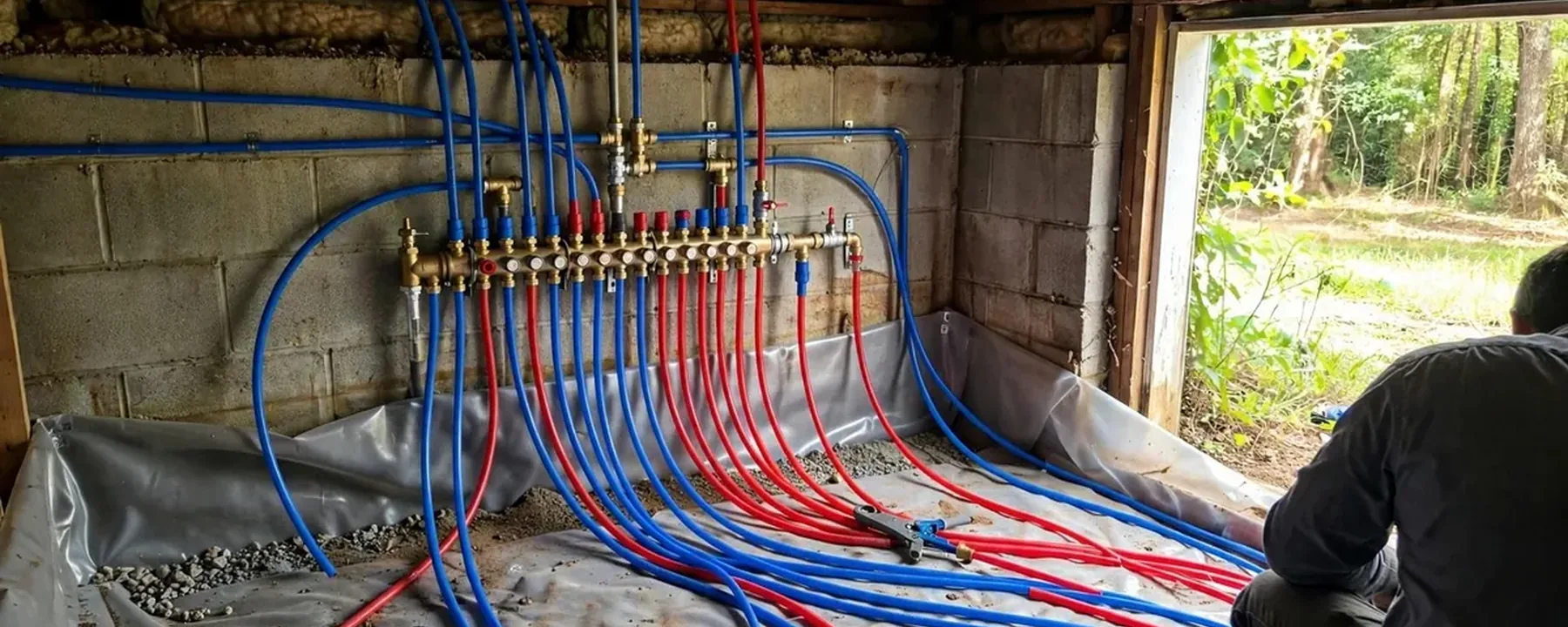
A whole-house repipe usually takes days, not hours, and the exact length depends on the house. A small home with open basement ceilings can often be piped in a few days, while a larger house with finished walls, plaster and several bathrooms can run a week or more. Wall and ceiling patching comes after that and adds its own time.
Think of it in three parts. First comes the walkthrough and permit, then the pipe work itself, then the inspection and repairs to the walls. A good plumber walks the house before quoting and gives you a schedule that says when the water will be off each day.
What stretches or shortens the job
Two houses of the same square footage can take very different amounts of time. These are the factors that move the schedule the most.
| Factor | Usually faster | Usually slower |
|---|---|---|
| Access to the pipes | Unfinished basement ceiling or open crawl space | Pipes behind tile, plaster or a finished ceiling |
| Number of fixtures | One bathroom and a kitchen | Several bathrooms, a laundry and outdoor spigots |
| New pipe material | Flexible PEX, which can be fished through walls | Rigid copper, which needs more joints and soldering |
| Wall construction | Drywall, which is easier to cut and patch | Plaster over lath, which is slower to open and repair |
| Number of floors | One or two levels with a straight run | Three levels, or pipes that wander through old chases |
| Occupied or empty house | Empty house, full access to every room | Furniture, belongings and people to work around |
These are general patterns, not promises. Your plumber should confirm timing after seeing your house.
How a repipe unfolds, from walkthrough to final patch
Every plumber sequences the work a little differently, but most repipes follow this outline.
The walkthrough
The plumber traces the existing lines, checks what material they are, finds the main shutoff and decides where new pipe can run. This is also the time to ask about access, patching and which rooms will be disturbed.
Permit and scheduling
In Abington the permit is pulled by a master plumber registered with the township. Booking the inspection ahead of time keeps the walls from sitting open longer than needed.
Rough-in
The crew runs new supply lines to each fixture, usually working room by room. Old lines are often left in place and capped, or removed where they are in the way, depending on the house.
Cutover
This is when the house runs on the new pipes. Water is shut off while the plumber ties the new lines into the main and each fixture, and the length of that shutoff depends on how many connections there are.
Inspection
The township inspector looks at the work before it is covered. Plan the patching start for after the inspection passes.
Patch and restore
Holes are closed, drywall is patched and paint matches. Some plumbers handle this, while others coordinate with a drywall or paint contractor, so ask who does it before you sign.
Thinking about a repipe?
Call and describe the house. We will tell you what a plumber needs to see before giving a schedule.
Why house age matters in Abington
Census American Community Survey estimates for 2020 to 2024 put the median Abington home at a build year of 1956, and about 61 percent of the township's homes were built before 1960. Houses from that period often have galvanized steel supply pipe, early copper or a patchwork of both. Those are the homes most likely to need a repipe conversation.
Source: U.S. Census Bureau, American Community Survey 5-year estimates for 2020 to 2024, tables B25034 and B25035. Estimates carry a margin of error.
Abington permits, inspections and the line from the street
In Abington, plumbing permit applications must come from a master plumber registered with the township, and that plumber schedules the inspections. The township code says plumbing work must be inspected and approved before it is covered. For you, a repipe quote should name who pulls the permit and when the inspection happens, and Code Enforcement is at 267-536-1000, extension 4, if you want to confirm.
The pipe from the street is a separate question. Aqua Pennsylvania says it owns the line from its main to the curb stop, and the customer owns the line from the curb stop into the house. Aqua's 2026 update says its inventory of customer-owned service lines in Abington was nearly 75 percent complete, with more than 260 lines flagged for replacement in a project scheduled for 2027.
Aqua says the lead program covers the service line, not the pipes inside your house. So do not hold an interior repipe for Aqua's schedule, but do ask Aqua at 877-987-2782 whether your service line is on its lead inventory.
The township's water conservation code sets flow limits for fixtures on new or altered plumbing under permit, 1.6 gallons per flush for toilets and 3.0 gallons per minute for showerheads and faucets, so buy compliant fixtures if you replace them at the same time.
Source type: Abington Township code of ordinances and permit forms, Aqua Pennsylvania lead service line program and Abington study update, and Census American Community Survey estimates
Living in the house while it happens
Water will be off in stretches
Ask for the plan each morning. Fill a few containers for drinking and flushing, and know where the nearest working bathroom is.
Expect dust and noise
Cutting into walls and ceilings is messy. Cover furniture, seal off doorways with plastic and keep children and pets away from work areas.
Clear the way
Empty closets, move furniture away from walls and clear the path from the basement to every bathroom. Access is the biggest schedule factor you control.
Plan your meals
If the kitchen sink or dishwasher is off, paper plates and a cooler save a lot of frustration.
Know the hot water plan
The water heater is usually off while the new lines are tied in. Ask when hot water returns and whether the plumber will flush the lines when the water is back.
Questions that make a repipe quote clearer
A repipe quote should list what is included, not only a total. Ask these before you agree to anything.
- Who pulls the permit? In Abington it must be a registered master plumber, and the quote should say so.
- What pipe material? Ask whether the plan uses PEX or copper and why the plumber chose it for your house.
- How many days with the water off? Get a plain answer on how long the house will be without water at one stretch.
- Who patches the walls? Find out whether drywall and paint are included or handled separately.
- What happens to the old pipe? Ask whether it is removed or left in the walls, and what the house records will show.
Is a repipe the right call, and what comes first?
Not every old house needs a full repipe. A single leak in healthy pipe is a repair, but repeated leaks, rust-colored water or weak flow at several fixtures can point to pipes that are wearing out. Our repiping page explains how a plumber decides, and leak detection can show whether a leak is isolated or one of many.
If a pipe has already split, deal with that first. The burst pipe repair page covers the emergency steps, and the water service line repair page covers the section between the curb and your house. We serve nearby towns such as Wyncote and Jenkintown as well, and the 24/7 line is open when a pipe fails after hours.
Repipe timing questions from Abington homeowners
It depends on the house. A small home with open basement ceilings can often be done in a few days, while a larger house with finished walls and several bathrooms can take a week or more. Patching the walls comes after the pipe work.
Many people do, though the water is off for stretches each day and the house is dusty. If you have young children, medical needs or no second bathroom, ask the plumber about the plan or arrange to stay elsewhere for the longest water-off days.
It varies by job. The water is off while connections are made, and some plumbers restore it at the end of each work day. Ask for the water-off plan in writing so you can prepare.
Plumbing permit applications in the township must come from a master plumber registered with the township, and that plumber schedules the inspections. The township code says work must be inspected and approved before it is covered, so patching starts after the inspection passes.
Usually not. Aqua Pennsylvania owns the line from its main to the curb stop, and the customer owns the line from the curb stop into the house. A repipe covers pipes inside the house, and the service line is a separate project.
Older pipe is more likely to wear out. The median Abington home was built in 1956 per Census estimates, and about 61 percent predate 1960, so many have galvanized or early copper pipe. Age alone is not proof, and a plumber should inspect the actual pipes.
Usually before, or at the same time, because the walls are already open and the plumber can reach the pipes easily. Doing a repipe after new tile and drywall means cutting into finished work.