
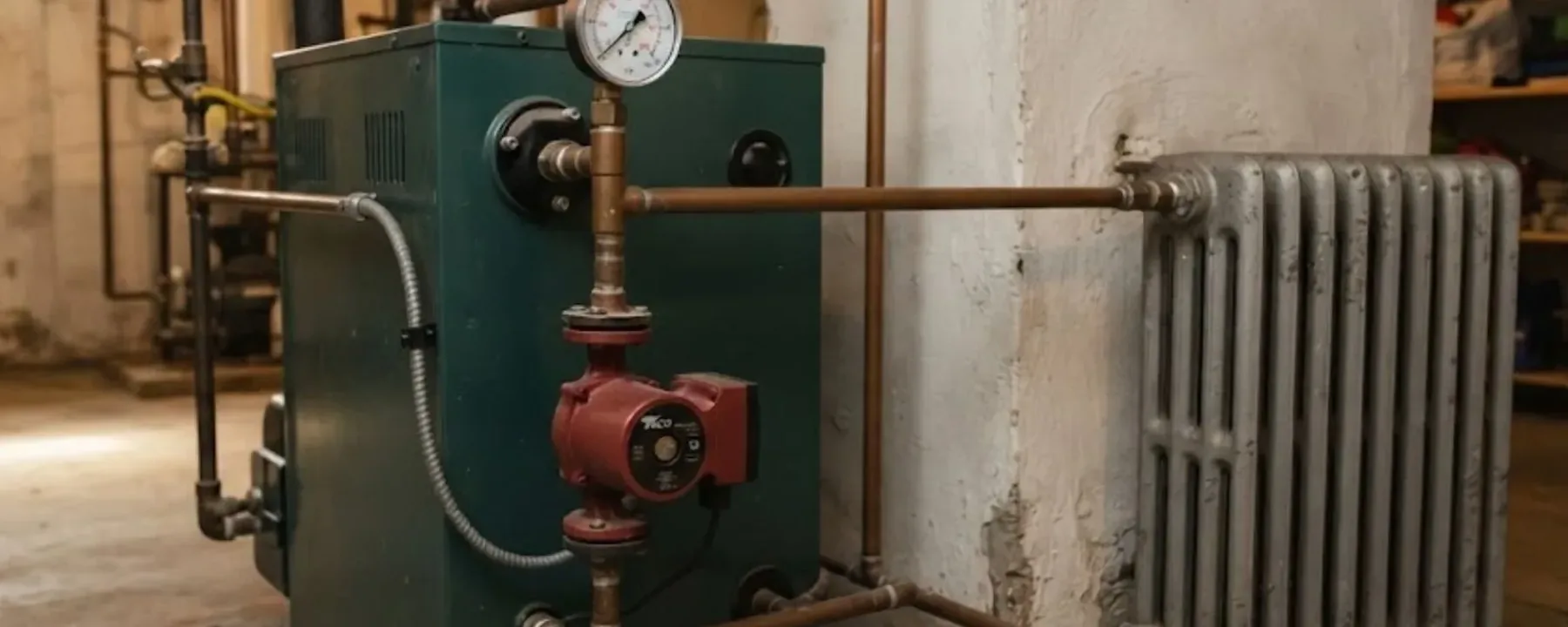
Boiler repair means finding out why a boiler that heats water or makes steam is not sending warmth to your radiators, baseboards or floor loops, then fixing that part. In many houses the cause is simple, such as a thermostat setting, a switch turned off, low water pressure or an igniter that will not light. Plumbers ask about those first, so it saves time to check them before you call.
If you smell gas at any point, stop and leave the building before you do anything else. If the checks do not bring the heat back, call (215) 714-6692. The line answers 24/7.
No heat tonight? Check these six things before you call
Work through the list in order. Each check takes a minute or two and needs no tools.
- Thermostat Set it to heat and raise it about five degrees above the room temperature. Replace the batteries if it uses them. A blank screen points to the thermostat or its power, not the boiler.
- Power Most boilers have a switch that looks like a light switch near the unit or at the top of the basement stairs. Make sure it is on, then check the breaker. A boiler that is off at either place does nothing at all.
- Fuel Check that the gas valve at the boiler is open, with the handle running along the pipe. If your system burns oil, look at the tank gauge. An empty tank is a common reason for a cold house.
- Pilot or igniter Older boilers keep a small pilot flame lit. Newer ones use a spark or hot surface igniter and may show a fault light. If you smell gas, do not try to relight anything and follow the gas safety box below.
- Pressure gauge A hot water boiler often reads somewhere near 12 to 15 psi when cold, but the label on your unit rules. A reading near zero means water has been lost. A steam boiler has a sight glass instead, and the water level should sit near the middle.
- Radiator tops Touch a radiator at the top and at the bottom. Hot at the bottom and cold at the top on a hot water system usually means trapped air, which a bleeder key can release. On a steam system, a radiator that stays cold may have a stuck vent.
Steam or hot water: which system is in your basement?
The two systems fail in different ways, so the plumber's first question is which one you have. Compare your boiler and a radiator with the table. A guess is fine, because the plumber confirms what you have on the first visit.
| What to look at | Steam system | Hot water system |
|---|---|---|
| Gauge or glass | A vertical glass tube shows the water level, plus a low-pressure gauge | A round gauge shows pressure and often temperature |
| Pipes at a radiator | Often one pipe in, with a vent near the far end of the radiator | Two pipes, a supply and a return, often with a valve at each end |
| What fills the radiator | Steam rises in, gives off heat and turns back to water | Hot water is pushed through by a circulator pump |
| Usual sounds | Hissing at vents and some knocking as steam moves | Quiet apart from the pump hum and a gurgle when air is in the lines |
| Where trapped air goes | Out through the radiator vents | Out through bleeder valves or an air separator |
Common boiler faults and what they usually point to
No heat at all
The thermostat, the power switch, the fuel supply or a safety lockout is the usual suspect. Run the six checks above first. If the boiler clicks without lighting or shows a fault light, note the pattern for the plumber.
Banging or knocking pipes
On steam, knocking often means water is pooling in a pipe that should slope back to the boiler. On hot water, banging or ticking can be air in the lines or a pump problem. Pounding that starts suddenly deserves a prompt call.
A relief valve that drips
The valve opens when pressure or temperature runs too high. A drip can come from a worn valve, a failed expansion tank or a fill valve that keeps feeding water. Never cap it or plug its discharge pipe.
Low pressure
A hot water boiler that loses pressure has lost water through a leak, an open bleeder or the relief valve. Refilling once is reasonable if your manual shows how. Repeated refilling means the leak must be found, see leak detection.
Thermostat not calling for heat
The boiler sits idle because it never gets the signal. Dead batteries, a wrong mode or a loose wire are common causes. The thermostat section below covers what to try.
House cold and the boiler will not start?
Run the six checks, then call. The line is open 24/7 and same-day appointments are offered when available.
When the thermostat is the problem, not the boiler
A boiler fires only when the thermostat closes a circuit. If the screen is dark or the dial is loose, the boiler never hears the request. Fresh batteries, the right mode and a setting well above room temperature solve many no-heat calls.
Age and wiring are the other causes. Older dial thermostats can drift out of calibration, so the house runs colder than the setting. Some smart thermostats need a common wire that old boiler wiring lacks, which is worth checking before you buy one.
To test, set the thermostat to heat and listen at the boiler for a click or a circulator pump starting within a minute or two. If nothing happens there, tell the plumber what you heard. That one detail separates a thermostat fault from a boiler fault.
Gas smell or carbon monoxide alarm: leave first
Natural gas is given a rotten-egg smell so leaks get noticed. If you smell it near the boiler, leave the building at once and do not flip switches or use a phone inside. Call your gas utility or 911 from outside, and call the plumber only after that.
A carbon monoxide alarm is a separate emergency. If it sounds, get everyone into fresh air and call 911, and do not silence it and go back in. Keep working alarms near sleeping areas, test them on a schedule and replace them when the label says so.
Where a plumber's boiler work ends and a heating contractor's begins
Plumbers handle many boiler repairs, especially anything on the water side of the system. Burner and combustion work is different, and a heating contractor may be the right call. If your problem falls on that side, we will tell you plainly instead of guessing.
Often handled by a plumber
- Leaking relief valves and fill valves
- Expansion tank replacement
- Circulator pump replacement
- Leaking radiator valves and heating pipe
- Air vents and bleeders
- Thermostat swaps
May need a heating contractor
- Burner and combustion adjustment
- Oil burner service
- Flue and venting faults
- A cracked heat exchanger or boiler section
- Control board and gas valve faults
- Full boiler replacement planning
Older Abington houses and the boilers some of them have
The median home in Abington Township was built in 1956, and about 61 percent of the 23,232 homes predate 1960, according to Census American Community Survey estimates for 2020 to 2024. No data we found says how many of those homes use a boiler, so we do not claim it is common.
What the numbers show is that the township has many houses of the age that sometimes have steam or hot water radiator systems. The plumber confirms what you have.
If you do have radiators, ask what the heating pipes are made of and whether the supply lines nearby are the same age. A plumber already in the basement can look at both, and a pattern of leaks may point toward repiping. The advice is the same in older sections of Glenside, such as Ardsley, which the township's history chapter says was planned in 1918 and 1919.
What decides the price of a boiler repair
A boiler quote depends on what the plumber finds, so you get a clear price before work starts. These are the things that move it.
If replacement comes up, ask Abington Township's Community Development office whether a permit applies, since no township permit for boiler replacement is listed on its residential forms page. A boiler that also supplies your hot water may involve water heater repair as well. Want your real number? Call (215) 714-6692.
Call for your priceWhy the first cold snap shows which boilers are weak
NOAA 1991 to 2020 normals put the average last spring freeze near April 4 and the first fall freeze near November 7 at the Philadelphia Northeast Airport station. That freeze window runs about five months, and a boiler often works hardest inside it. A unit that sat idle all summer commonly shows its faults on the first cold night.
A house with no heat in a freeze also puts pipes at risk. Water lines in outside walls and unheated garages can freeze within a day or two once the house cools. If the boiler cannot be fixed quickly, ask the dispatcher about protecting pipes, and see burst pipe repair for what to do if one splits.
Boiler repair questions from Abington homeowners
On a hot water system, trapped air or a stuck circulator pump is a common cause, and bleeding the radiators sometimes helps. On a steam system, a stuck radiator vent or low boiler water can keep steam from reaching the radiator. Tell the plumber which type you have.
Look for a vertical glass tube showing a water level, which marks a steam boiler. A round pressure gauge with no glass tube suggests hot water. Radiators with one pipe and an end vent are often steam, and two pipes often mean hot water.
No. The relief valve is a safety device that opens when pressure or temperature is too high, so a drip means something is wrong. It may be a worn valve, a failed expansion tank or a fill valve that overfeeds. Do not cap it.
Many hot water boilers read somewhere near 12 to 15 psi when cold, and a little higher when hot. The label on your unit is the better guide. A reading near zero or in the red zone is a reason to call.
A plumber handles many repairs, especially relief valves, expansion tanks, pumps, valves and leaking pipe. Burner and combustion work, flue problems and cracked heat exchangers may need a heating contractor. We will tell you which side your problem is on.
No township permit for boiler replacement is listed on the residential forms page, but that is not the same as a confirmed answer. Ask Community Development, which administers the township's plumbing and mechanical ordinances, at 267-536-1000, press 4.
On steam, banging often means water is trapped in a pipe that does not slope back to the boiler. On hot water, air in the lines or a pump fault can cause knocking or ticking. A plumber can trace which one by listening along the pipe.
Get everyone outside into fresh air and call 911. Do not silence the alarm and go back in. The boiler and any fuel-burning appliance should be checked before you use them again.
Yes. The dispatch line is open 24/7, and same-day appointments are offered when available. A no-heat call in a freeze is worth making at any hour, because cold pipes can split.