
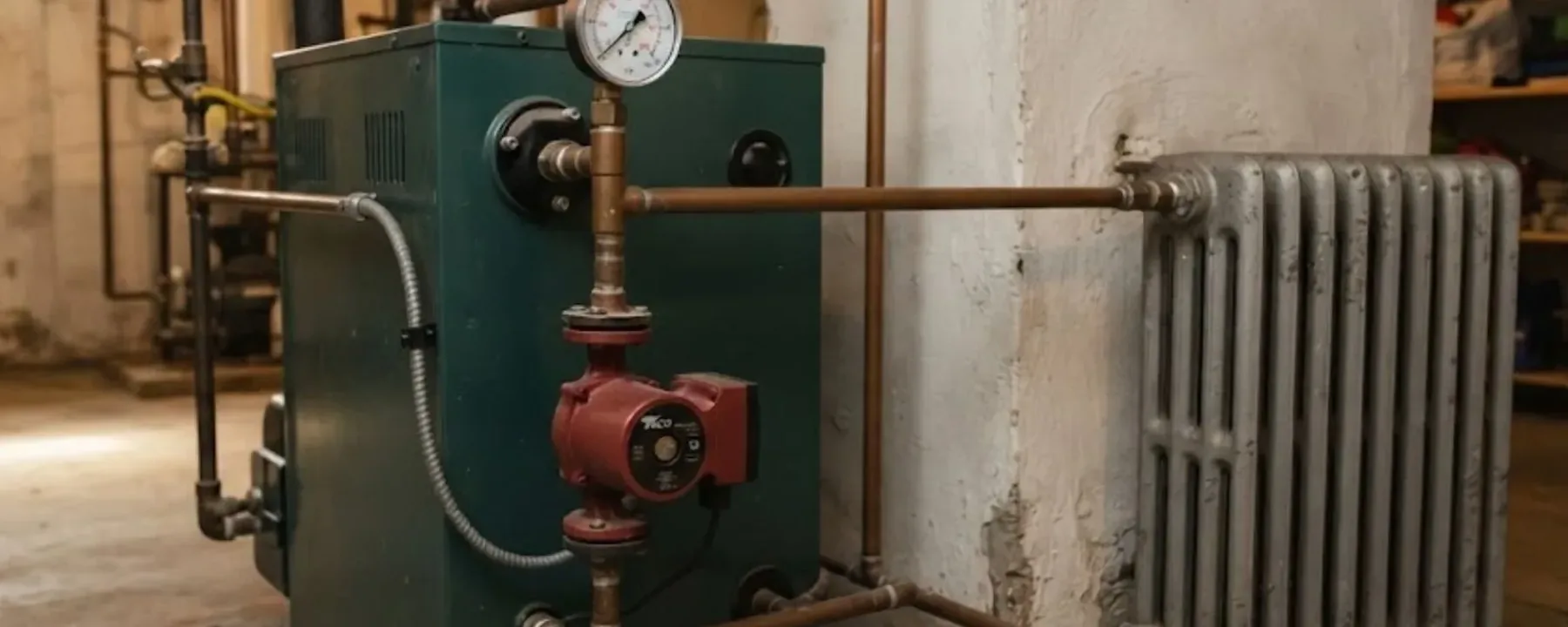
When a boiler thermostat stops working, the cause is usually simple. Dead batteries, the wrong mode or setpoint, and a boiler switched off at its own service switch or breaker explain a large share of cold-house calls. Check those three first, and if the display is blank, start with fresh batteries.
If the thermostat looks normal but the boiler never fires, the fault may sit in the wiring or in the boiler itself, and that is a job for a licensed plumber or heating technician. If you smell gas at any point, leave the building right away and call the gas utility or 911 from outside, before you call us or anyone else.
First, make sure you are looking at a boiler
This guide applies if hot water or steam from a boiler heats your radiators or baseboards. Plenty of houses heat with forced air instead, and those thermostats follow different rules. Look in the basement for a boiler with pipes running off it to radiators or baseboard units, or ask whoever services your heat.
The thermostat on the wall is only a switch that tells the boiler when to heat. It does not heat anything itself. That is why a thermostat problem and a boiler problem can look identical from the living room.
The checks to run, from easiest to hardest
Go in this order. Most of these take a few minutes, and none of them requires opening the boiler.
Look at the display and swap the batteries
A blank screen or a low-battery warning points to batteries. Replace them with fresh ones of the type printed in the battery bay, and give the unit a minute to restart.
Confirm the mode and setpoint
The thermostat should read Heat, with the target several degrees above the room temperature. Check that a schedule or a hold setting is not overriding what you just set.
Check that the boiler has power
Most boilers have a service switch, often shaped like a light switch, on or near the unit. Make sure it is on. Then check the breaker at the panel, flipping it fully off and on once if it looks tripped.
Read the boiler's own light or display
Many boilers show a status light or an error code. Write down exactly what it shows, because that helps the technician. Do not press the reset button over and over, since repeated resets can hide a real fault.
Look for a pattern
Does the heat come on late, shut off too soon or run all day? A thermostat sitting in direct sun, near a draft or on a cold exterior wall can misread the room and give the boiler the wrong signal.
Stop and call
If these checks do not bring heat back within a short time, call. Tell the dispatcher what the thermostat shows, what the boiler shows and what you already tried.
What each symptom usually means
The symptom narrows the field. This table shows the common cause and who normally fixes it.
| What you see | Common cause | Who fixes it |
|---|---|---|
| Blank thermostat screen | Dead batteries, or no power reaching a hardwired unit | You for batteries. A pro if fresh batteries change nothing |
| Thermostat says heat, boiler stays silent | Boiler switched off, a tripped breaker, or the boiler has locked out | You for the switch and breaker. A pro for a lockout |
| Boiler runs but radiators stay cold | Air in the system, low pressure or a circulator pump problem | A pro. Do not add water to a hot boiler yourself |
| Heat will not shut off | A stuck thermostat, a wiring fault or a failed boiler control | A pro. Turn the thermostat down and, if needed, switch off the boiler's service switch |
| Thermostat clicks, nothing follows | A weak low-voltage signal from a loose wire or a failing part | A pro with a meter |
| Wrong temperature reading | Poor location, dust or a drifting sensor | You can clean or relocate. Otherwise replace |
House cold and the checks did not help?
Call the 24/7 line, tell the dispatcher what the thermostat and boiler show, and ask about a same-day visit.
Signs the problem is the boiler and not the thermostat
Strange noises
Banging, loud gurgling or a squeal from the boiler room points to the boiler or its pump, not a wall control.
Water around the boiler
Damp floor, drips or rust stains near the unit mean a leak. A boiler that keeps losing pressure may also have a hidden leak somewhere in the heating pipes, and leak detection can help find it.
Error code or lockout light
A steady fault light or a code on the boiler display is the boiler reporting its own problem.
No hot water either
If your boiler also makes the household hot water and both are out, the fault is probably at the boiler. A separate tank may need water heater repair instead.
Soot or a burning smell
Black marks near the unit or a scorched smell are warning signs. Switch off the boiler and call. If you also smell gas, leave first.
Heating controls and permits in Abington
Abington's township code lists repair and replacement of control devices for heating and air-conditioning equipment among the residential work that still requires a permit. The township's HVAC permit application also asks for unit specifications and a separate electrical permit application. For you, swapping batteries needs nothing, but if your contractor replaces a control device or rewires it, ask whether the job will be permitted through Code Enforcement at 267-536-1000, extension 4.
PECO's customer handbook says to have your house heater inspected and cleaned at least every two years, and the federal Consumer Product Safety Commission says to put battery-operated or battery-backup carbon monoxide alarms on every level and outside sleeping areas. Treat that as a floor, not a ceiling, and ask your technician how often your unit needs service. A boiler that has been checked is less likely to leave you with a cold house on a January night.
Source type: Abington Township code of ordinances and permit forms, PECO customer safety guidance, and Consumer Product Safety Commission carbon monoxide guidance
A word on thermostat wiring
Most boiler thermostats work on a low-voltage circuit. The thermostat calls for heat by connecting two small wires at its base, and the boiler responds. A loose, corroded or damaged wire can break that call even when the thermostat itself is fine.
Some baseboard systems use line-voltage thermostats that carry full house current. Those are electrician territory, and a shock risk if you open them. Before you touch any wiring, shut off power at the breaker, photograph the terminals so you can reconnect them, and stop if anything looks burned or brittle.
Do it yourself or call
Fine for a homeowner
- Replacing thermostat batteries
- Checking the mode, setpoint and schedule
- Flipping the boiler service switch or a tripped breaker once
- Dusting the thermostat and moving a misleading sensor
- Photographing the boiler's error code
Leave to a licensed pro
- Opening the boiler or working near the burner
- Relighting a pilot or touching a gas valve
- Rewiring or replacing a hardwired control
- Adding water or changing boiler pressure
- Repeated lockouts or any smell of gas
Gas smell or carbon monoxide alarm
If you smell gas, leave the building immediately and do not flip switches or use anything electrical on the way out. Call your gas utility or 911 from outside or from a neighbor's phone. Call a plumber only after the utility says the house is safe. If a carbon monoxide alarm sounds, or anyone has a headache, dizziness, nausea or confusion, get everyone outside and call 911.
When to call us
Call the 24/7 line if the house is cold and the checks above did not help, if the boiler keeps locking out, or if you see water around the unit. A dispatcher will ask what the thermostat and boiler display show, and will tell you whether a boiler repair visit is available the same day. We dispatch to homes across the township and to nearby towns such as Jenkintown and Elkins Park.
Boiler thermostat questions from Abington homeowners
Dead batteries are the most common reason. Replace them with fresh ones. If the screen stays blank, the thermostat may be hardwired and not getting power, which points to a tripped breaker, a loose wire or a failed part that a plumber or electrician should check.
The thermostat only sends the request. The boiler may be switched off, locked out, low on pressure or have air trapped in the system. Check the boiler's service switch and display, then call if the radiators stay cold.
Some people swap a low-voltage thermostat safely, but you must shut off power first and label every wire. Line-voltage thermostats, and any job where you are unsure what you are looking at, should go to a licensed pro.
Leave the building at once without switching anything on or off. Call your gas utility or 911 from outside or from a neighbor's phone. Do not call a plumber first, and do not go back inside until the utility says it is safe.
Township code lists repair and replacement of heating control devices among the work that still requires a permit. Ask your contractor to confirm with Code Enforcement at 267-536-1000, extension 4, before work starts. Changing batteries needs no permit.
PECO's customer handbook says to have a house heater inspected and cleaned at least every two years. Your boiler maker or technician may recommend a different interval for your unit, so ask when you book the visit.
One reset after a lockout is common. Pressing it repeatedly can hide a real fault, such as a failing ignition part or a blocked vent. If the boiler locks out again, leave it off and call.